


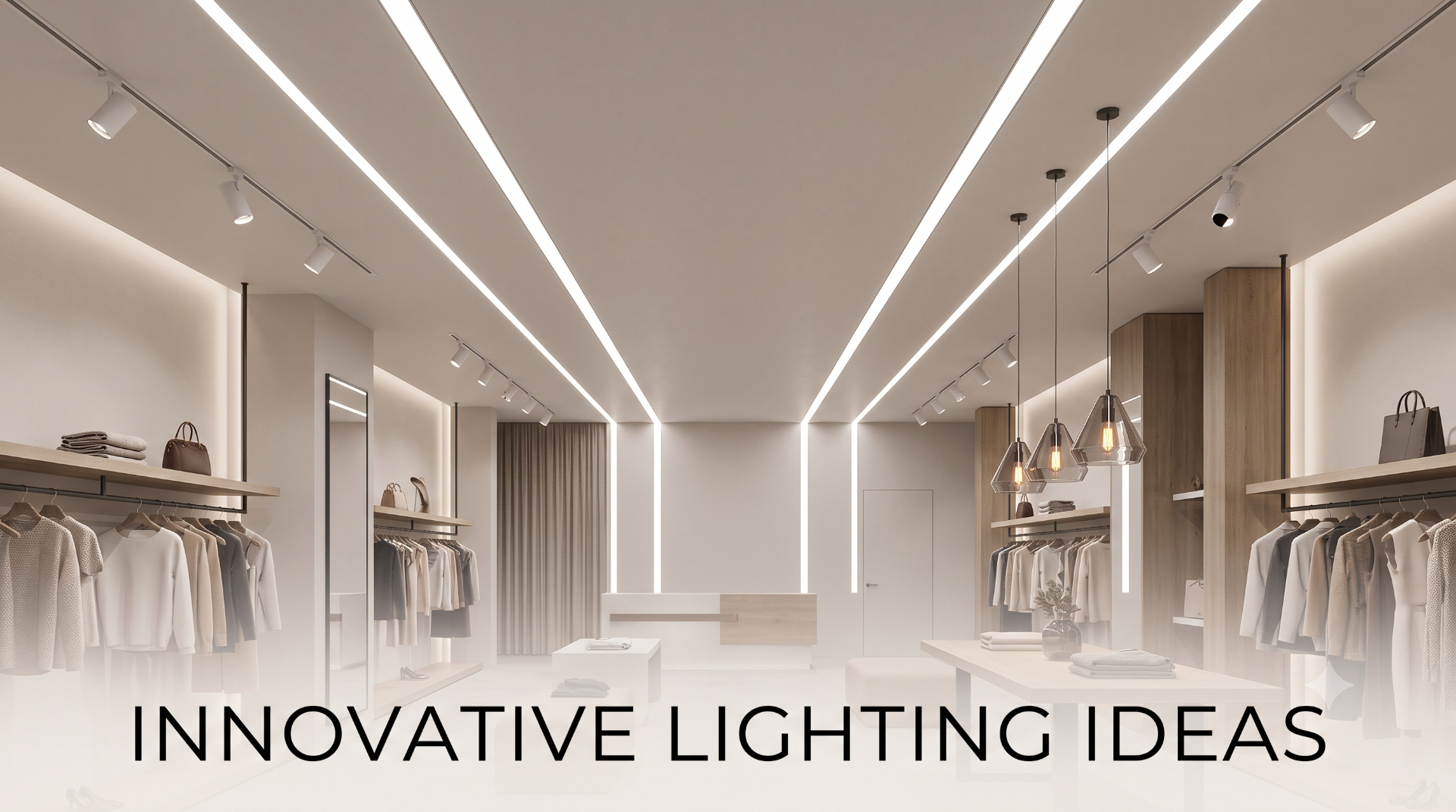
Retail lighting has changed considerably. It is no longer simply about making products visible or keeping a store sufficiently bright. In a modern retail environment, light helps customers understand the space, discover products, recognise important displays and experience the character of the brand.
This becomes particularly important in contemporary retail spaces, where open layouts, carefully selected materials and flexible merchandising are increasingly common. The lighting needs to work with all of them without becoming a distraction.
A successful lighting scheme is therefore built around a simple principle: light should have a purpose. Some fixtures establish comfortable general illumination, some guide movement, some bring attention to merchandise, while decorative fixtures contribute to the visual identity of the store.
For UAE retailers, this approach is particularly relevant across boutiques, fashion stores, lifestyle outlets, showrooms, department stores and contemporary commercial interiors. The right combination can make a space easier to navigate while giving individual areas their own character.
Why Lighting Matters in Modern Retail Design
Customers do not experience a store as a collection of products alone. They experience the complete environment.
Lighting affects the perceived proportions of the space, the appearance of materials, the prominence of displays and the atmosphere around the shopping journey. It can also establish a visual hierarchy, helping customers understand which areas deserve attention first.
A completely uniform lighting scheme may provide adequate visibility but leave the store visually flat. At the other extreme, excessive accent lighting can make the environment feel busy.
The objective is balance.
Modern retail lighting should provide:
- Comfortable overall illumination
- Clear visibility of merchandise
- Visual emphasis where required
- A logical customer journey
- A coherent relationship with the interior design
- Flexibility for changing displays
- A comfortable environment for staff and customers
1. Start with a Strong Ambient Lighting Layer
Ambient lighting creates the foundation of the retail environment.
Recessed and surface lighting can provide general illumination while maintaining a clean visual structure. Linear lighting can also work particularly well where the store architecture features long ceiling lines, corridors or geometric layouts.
The important consideration is not simply how many fixtures are installed. It is how the light is distributed across the floor.
A store should not have unnecessarily bright circulation areas beside noticeably darker merchandise zones unless that contrast is intentional.
The lighting layout should be considered alongside shelving, display tables, fitting rooms, counters and customer pathways.
Jaquar UAE's indoor lighting portfolio includes recessed, surface, linear, track and general lighting solutions, providing different approaches to establishing this functional foundation.
2. Create Visual Hierarchy with Accent Lighting
One of the most effective ways to make retail interiors more engaging is to avoid giving every product and every area exactly the same visual emphasis.
Accent lighting allows selected merchandise, displays or architectural elements to become focal points.
Track lighting is particularly useful when flexibility is important. Individual fixtures can be directed towards displays or merchandise areas rather than relying entirely on fixed illumination.
This can be valuable in fashion stores where product layouts change regularly.
The same principle works in lifestyle retail. A carefully illuminated feature display can attract attention from the main circulation route and encourage customers to explore that part of the store.
The goal is not to illuminate everything more strongly. It is to decide what deserves attention.
3. Use Track Lighting for Flexible Merchandising
Retail environments rarely remain static.
New collections arrive. Seasonal products move. Window displays change. Product categories are rearranged.
Lighting should therefore be capable of adapting to the merchandising strategy.
Track lighting can support this flexibility because the direction of individual lights can be adjusted according to the location of displays.
A retailer can use this to refresh the visual emphasis of a store without completely changing the ceiling layout.
This is particularly useful for fashion, accessories, lifestyle products and showrooms where display arrangements can change frequently.
4. Turn Linear Lighting into an Architectural Element
Linear lighting does not always need to disappear into the ceiling.
In modern retail interiors, linear forms can become part of the architecture itself.
A linear lighting arrangement can reinforce a long aisle, define a transition between zones or complement geometric ceiling details.
When used consistently, it can create rhythm and help customers understand the structure of the store.
The key is integration. The lighting should appear to belong to the architecture rather than looking like an independent element added afterwards.
5. Use Pendant Lighting to Create Focal Areas
Pendant lights can introduce a different scale of lighting into retail environments.
They can be particularly effective above cash counters, consultation areas, feature displays or selected sections of a showroom.
Because they hang closer to eye level, pendants can also make a large retail environment feel more human and less purely commercial.
A carefully selected pendant can contribute to the store's visual identity without requiring extensive decorative treatment elsewhere.
Jaquar's decorative lighting range includes pendant options that can be integrated into selected retail zones where the fixture itself is intended to contribute to the interior character.
6. Use Decorative Lighting Selectively
Decorative lighting is most effective when it has a clear role.
A chandelier or distinctive pendant can establish a focal point at an entrance, reception area or central display. Wall lamps can bring attention to architectural surfaces or create a more layered environment around selected customer zones.
However, decorative fixtures should not compete with merchandise.
A retail store already contains visual information through packaging, displays, signage, furniture and products. Lighting needs to organise this information rather than add unnecessary noise.
One strong decorative element can often achieve more than several unrelated fixtures.
7. Make the Entrance Work Harder
The entrance is the first transition between the outside environment and the retail interior.
Lighting can help establish that transition.
A slightly stronger visual emphasis around the entrance can make it easier to identify from the surrounding commercial environment. Once inside, the lighting can gradually transition toward the main retail area.
This does not require an excessively bright doorway.
The entrance should simply have enough visual definition to feel intentional and connected to the interior.
For stores in malls or busy commercial areas, this can be particularly useful because customers are moving through a visually crowded environment before entering the store.
8. Guide Customers Through the Store
Lighting can influence movement without becoming obvious.
A sequence of illuminated displays can naturally encourage customers to move deeper into a store. A brighter feature area can establish a destination. Consistent ceiling lighting can clarify the primary circulation route.
The approach should be subtle.
Retailers do not need to create dramatic contrasts everywhere. Instead, changes in emphasis can provide visual cues.
For example, the entrance can introduce the store, the central area can contain the strongest merchandise presentation, and a secondary section can use more focused lighting around selected products.
This creates a visual journey.
9. Make Product Displays Stand Out
The product itself should remain the hero.
Lighting around display shelves, tables and freestanding units should support product visibility without producing distracting reflections or harsh shadows.
The angle of the light matters as much as its intensity.
For glossy packaging, glass surfaces or reflective finishes, poorly positioned fixtures can create unwanted highlights. For textured products, directional light can sometimes reveal material detail more effectively.
This is why lighting should be tested from the customer's actual viewing position.
A fixture that looks effective on a ceiling plan may produce a very different result from eye level.
10. Give Different Retail Zones Their Own Identity
Large stores can become difficult to navigate when every section looks identical.
Lighting can help create subtle distinctions.
A fashion section may use focused lighting around displays. A lifestyle section may incorporate decorative pendants. A showroom consultation area may use a calmer lighting treatment.
The objective is not to make every department dramatically different.
Instead, slight changes in fixture type, lighting emphasis or ceiling treatment can help customers understand that they have moved into a different part of the store.
11. Use Wall Lighting to Add Depth
Retail lighting is often dominated by ceilings, but walls can provide another important visual layer.
Wall lamps can help break up long surfaces and provide visual interest around entrances, seating areas or architectural features.
They can also be used where a retailer wants to create a softer environment around a consultation or waiting zone.
Wall lighting is particularly useful in stores where the architecture itself is part of the customer experience.
12. Use Outdoor Lighting to Connect Exterior and Interior
For retail spaces with external façades, entrances, walkways or landscaped areas, outdoor lighting can extend the brand experience beyond the front door.
Outdoor wall fixtures can help define entrances and vertical surfaces. Other outdoor lighting solutions can support pathways and external areas according to their intended use.
The objective is continuity.
A carefully designed interior can lose some of its impact if the transition from exterior to interior feels disconnected.
Jaquar UAE's outdoor lighting portfolio provides different categories for exterior applications, allowing retailers to consider the surrounding environment as part of the overall lighting design.
13. Consider Daylight in UAE Retail Spaces
Natural daylight can significantly change the appearance of a retail interior.
Stores with large glazed façades may receive substantial daylight during parts of the day, while enclosed retail units may rely more heavily on artificial illumination.
The artificial lighting plan should account for these changing conditions.
A store does not necessarily need to maintain exactly the same visual balance from morning to evening.
Where appropriate controls are available, different lighting zones can be adjusted to complement changing daylight conditions.
This can also help maintain a consistent visual experience throughout the trading day.
14. Choose Lighting According to Ceiling Height
The height and structure of the ceiling influence fixture selection.
Low ceilings often benefit from integrated, recessed or compact surface solutions that preserve visual openness.
Higher ceilings provide more opportunity for pendants and chandeliers to become architectural focal points.
Large retail spaces can also use linear lighting to reinforce the scale of the ceiling and establish visual direction.
The fixture should always be proportional to the surrounding architecture.
15. Use Colour Temperature Carefully
Colour temperature can influence how customers perceive the retail environment and the products within it.
Warmer illumination can create a more relaxed and inviting atmosphere, while neutral illumination can provide a cleaner and more contemporary appearance.
The appropriate choice depends on the store category, materials, merchandise and brand identity.
Consistency is particularly important where customers move between connected areas.
A dramatic change in light colour between adjacent departments can make the store feel fragmented unless the difference is intentional.
16. Think About Staff Comfort Too
Retail lighting is often planned entirely around customers, but employees spend considerably more time in the environment.
Staff areas, counters, stock-related circulation and consultation zones should therefore receive appropriate illumination.
The objective is to create a comfortable environment throughout the working day without making customer-facing areas unnecessarily bright.
A good retail lighting scheme works for both audiences.
17. Avoid Common Retail Lighting Mistakes
Making everything equally bright: This removes hierarchy and can make the store visually flat.
Using too many decorative fixtures: Retail already contains a large amount of visual information.
Ignoring glare: Customers should not constantly encounter harsh light sources while browsing.
Lighting the ceiling instead of the merchandise: The product should remain the visual focus.
Forgetting changing displays: Fixed lighting can become restrictive when merchandising changes.
Ignoring the entrance: The transition into the store is an important part of the customer journey.
Mixing unrelated fixture styles: A collection of disconnected lighting designs can weaken the overall visual identity.
18. A Practical Approach to Selecting Retail Lighting
Start with the store layout.
Identify the entrance, primary customer route, display zones, counters, fitting areas, consultation areas and architectural focal points.
Then assign a lighting role to each zone.
General lighting provides the foundation. Track or focused lighting can support merchandise. Decorative lighting can establish selected focal points. Wall lighting can add depth. Outdoor lighting can connect exterior areas with the store.
Finally, review the scheme from the customer's perspective.
Walk through the store and ask:
- What do I notice first?
- Can I easily understand where to go?
- Are the products visually clear?
- Are any fixtures distracting?
- Does the entrance connect naturally to the interior?
- Do different departments feel distinct but related?
These questions often reveal issues that are not obvious on a technical plan.
Conclusion
Innovative retail lighting is not about filling a store with more fixtures. It is about using light strategically to shape the shopping experience.
Ambient lighting establishes comfort. Track and accent lighting direct attention. Linear lighting reinforces architecture. Pendant and decorative fixtures add character. Wall and outdoor lighting extend the experience beyond the ceiling and into surrounding spaces.
For modern UAE retail environments, this layered approach can create stores that are easier to navigate, more adaptable to changing merchandising and more connected to their architectural identity.
Jaquar's lighting portfolio brings together indoor, decorative and outdoor solutions that can be considered across these different layers. Choosing complementary fixture types within one broader lighting language can also make it easier to maintain consistency as the retail environment evolves.
FAQs
- What lighting is best for modern retail stores?
A layered approach usually works best. General indoor lighting can provide overall visibility, while track, focused, decorative and wall lighting can create emphasis around merchandise and architectural features. - How can lighting improve the retail customer experience?
Lighting can guide movement, establish focal points, make merchandise easier to notice and create a comfortable atmosphere throughout the shopping journey. - Why is track lighting useful in retail stores?
Track lighting provides flexibility because individual fixtures can be directed towards changing displays and merchandise areas as the store layout evolves. - Should retail stores use decorative lighting?
Yes, when used selectively. Pendants, chandeliers and wall lamps can strengthen the interior identity of entrances, counters, feature areas and selected displays. - How should outdoor retail lighting be planned?
Outdoor lighting should connect entrances, façades and surrounding areas with the interior while providing appropriate visibility and maintaining a consistent visual character.