


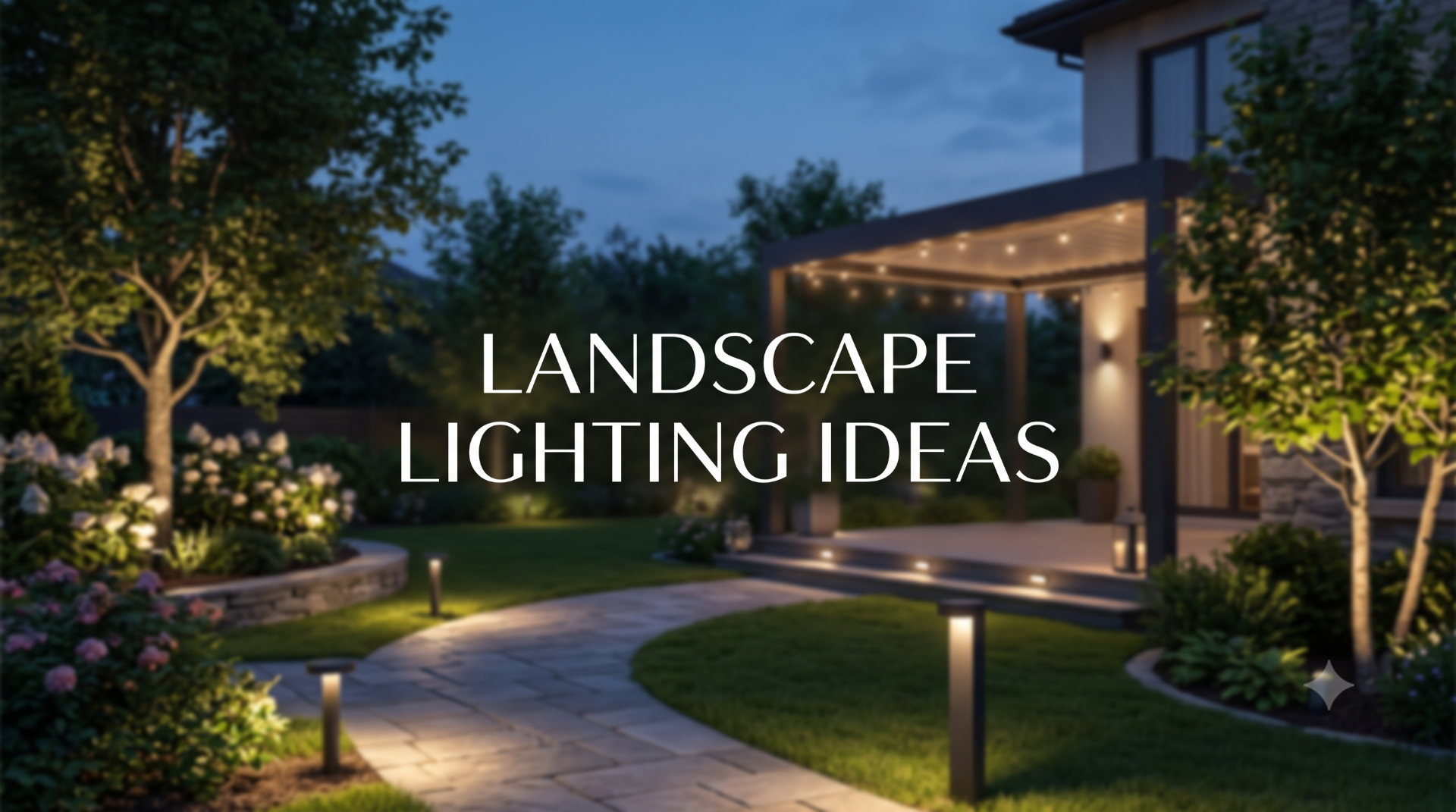
A garden changes character after sunset. Trees become silhouettes, pathways define themselves through pools of light, walls gain depth and outdoor seating areas become usable long after daylight fades. Good landscape lighting does not simply make a garden brighter. It determines what you notice, where you move and how comfortably the outdoor space can be used at night.
The challenge is getting the balance right.
Too little lighting can leave pathways, steps and entrances difficult to navigate. Too much can flatten the landscape, create glare and take away from the natural character of plants, trees and architectural features. The most effective outdoor lighting schemes usually combine several types of fixtures, each performing a specific role.
For a villa garden, terrace, driveway, courtyard or landscaped entrance, the starting point should always be the landscape itself. Look at how people move through the space, which features deserve attention and where visibility matters most. Then select lighting that supports those requirements.
This guide explores practical landscape lighting ideas for residential and outdoor spaces, including pathways, gardens, trees, walls, entrances and larger open areas. It also explains how to combine spike lights, bollards, ground-recessed lights, wall lighting, poles and projectors without making the landscape feel over-lit.
What Is Landscape Lighting?
Landscape lighting is the planned use of outdoor lighting to illuminate gardens, pathways, entrances, architectural features and other exterior areas after dark.
It generally serves three overlapping purposes:
- Visibility: helping people navigate outdoor spaces.
- Function: making gardens, entrances and outdoor areas more usable at night.
- Visual composition: highlighting selected landscape and architectural features.
The strongest designs balance all three.
Jaquar UAE's outdoor portfolio includes linear, projector, street-light, surface, pole, bollard, post-top, ground-recessed and wall-recessed categories. Its garden-lighting range also includes surface and wall-mounted solutions alongside dedicated outdoor lighting options.
1. Start With a Lighting Plan, Not Fixtures
One of the most common mistakes in landscape lighting is selecting fixtures before deciding what the outdoor space needs.
Walk through the property after sunset and identify:
- Main entrances
- Frequently used pathways
- Steps and changes in level
- Trees and planting areas
- Garden seating
- Driveways
- Boundary walls
- Architectural features
- Dark corners
- Areas that should remain visually quiet
This immediately separates essential lighting from decorative lighting.
For example, a pathway may require consistent visibility, while a mature tree may only need a small amount of accent illumination. Treating both areas identically usually creates an unbalanced result.
2. Illuminate Pathways With Bollards
Bollard lighting is particularly useful for defining outdoor paths and circulation areas.
Rather than lighting the entire garden, bollards establish a visual rhythm along the route. They can be used beside:
- Garden pathways
- Driveways
- Walkways between buildings
- Poolside circulation areas
- Villa entrances
- Larger landscaped areas
The important principle is consistency.
Bollards that are placed too far apart can leave obvious dark gaps. Placing too many close together can make the pathway feel overly bright and cluttered.
The ideal spacing depends on the fixture's light distribution, pathway width and surrounding illumination.
The goal is not to create a continuous line of brightness. It is to make the route visually understandable.
3. Use Spike Lights to Highlight Planting
Spike lights are useful when the landscape itself is the subject.
Because they can be positioned within planting beds, they can direct light toward selected trees, shrubs or garden features without introducing large structures into the landscape.
They work particularly well for:
- Trees
- Shrubs
- Flower beds
- Garden borders
- Sculptural planting
- Feature vegetation
Jaquar's garden-lighting portfolio includes spike-light solutions alongside bollards, wall lights and ground-recessed lighting.
Avoid illuminating every plant individually. Select a few visually important elements and allow the darker areas between them to provide contrast.
That contrast is what gives a garden depth at night.
4. Highlight Trees From the Ground
Trees often become some of the most effective features in a nighttime landscape.
A well-positioned ground or spike light can reveal the trunk, branches and canopy without needing to illuminate the entire tree.
For a mature tree, consider where its trunk divides and how its branches extend.
For smaller ornamental trees, a closer and more focused source may work better.
The key is to observe the tree from the main viewing positions. A lighting effect that looks attractive from one angle may disappear when viewed from the house or garden seating area.
5. Use Ground-Recessed Lighting for Clean Lines
Ground-recessed lights are useful when you want illumination to appear integrated into the landscape.
They can be used around:
- Pathways
- Driveways
- Landscape edges
- Architectural transitions
- Selected garden features
Because the fixture sits within or close to the ground plane, it can create a cleaner visual appearance than a prominent above-ground fixture.
Jaquar UAE lists ground-recessed outdoor lighting within its garden-lighting portfolio.
These fixtures should be selected according to the actual outdoor environment and installation requirements. Outdoor products differ in their resistance to dust and water, so the relevant product specifications matter.
6. Light Walls Without Flattening Them
Boundary walls, garden walls and architectural surfaces can look completely different at night.
A wall-mounted or recessed light can create pools of illumination, reveal texture or establish a visual boundary.
Instead of covering the entire wall with uniform brightness, consider creating selected areas of light.
For textured surfaces, grazing illumination can reveal the surface character.
For smooth walls, broader illumination may create a cleaner background.
The important point is to use the wall as part of the lighting composition rather than treating it simply as a surface that needs to be made bright.
7. Create a Welcoming Entrance
The entrance is one of the most important areas of an outdoor lighting scheme.
It needs to communicate where people should go while providing comfortable visibility.
Depending on the architecture, lighting can be introduced around:
- Gates
- Driveways
- Entry paths
- Boundary walls
- Entrance façades
- Landscape beds near the entrance
Pole and post-top lighting can also be useful where a larger area needs illumination.
Jaquar's UAE outdoor portfolio includes poles, bollards, post tops and other exterior categories suitable for different outdoor environments.
The entrance should generally be brighter than an ornamental section of the garden, but it should still feel connected to the rest of the property.
8. Use Pole Lighting for Larger Landscapes
Large villas, estates and expansive outdoor spaces may require illumination across a wider area.
Pole lighting provides a higher mounting position, allowing light to cover broader sections of a landscape.
It can be useful for:
- Large driveways
- Garden approaches
- Open outdoor areas
- Larger pedestrian routes
- Property entrances
However, pole lights should not be used simply because the garden is large. Their height and visual presence mean they become part of the landscape themselves.
Consider them as architectural elements as well as light sources.
9. Illuminate Outdoor Seating Areas
An outdoor seating area needs a different approach from a pathway.
People sitting outside need comfortable surrounding illumination, but direct glare can quickly become distracting.
The objective is to create enough ambient light to see faces, furniture and surrounding areas without placing bright sources directly within people's field of vision.
Where possible, use surrounding architectural or landscape lighting to support the seating area rather than pointing a powerful fixture directly toward it.
This creates a softer environment while maintaining useful visibility.
10. Use Layered Landscape Lighting
The best landscape schemes rarely rely on one fixture type.
A useful hierarchy is:
Base layer: general illumination for movement and orientation.
Path layer: bollards or suitable pathway lighting.
Feature layer: spike or ground-recessed lighting for selected plants and architectural elements.
Accent layer: carefully positioned projectors for larger features.
This approach creates depth.
Not every part of the landscape needs the same level of illumination. Some areas should remain darker so that the illuminated features have somewhere to stand out.
11. Highlight Architecture With Projectors
Projectors can be useful when a landscape includes larger architectural surfaces or features that need broader illumination.
They can be considered for:
- Building façades
- Large boundary structures
- Landscape features
- Open outdoor areas
Jaquar's UAE outdoor portfolio includes projector lighting as a dedicated category.
The key is aiming.
A projector pointed without considering viewing angles can create glare for people inside the property or on neighbouring areas. The beam should illuminate the intended feature while remaining visually controlled.
12. Use Light to Create Depth
A garden can look flat when every element is illuminated at the same intensity.
Instead, create three visual distances:
Foreground: paths, steps and areas people use.
Middle ground: planting beds, shrubs and smaller trees.
Background: walls, larger trees or architectural elements.
This creates depth without requiring more fixtures.
For example, a softly illuminated pathway in the foreground can lead toward a tree illuminated farther back. The eye naturally follows the sequence.
13. Landscape Lighting for Modern Villas
Modern villas often have strong architectural lines, large glazing areas and carefully designed outdoor spaces.
Landscape lighting should complement those lines rather than compete with them.
Ground-recessed lighting can maintain clean horizontal lines. Spike lights can highlight planting without introducing visually heavy structures. Bollards can define pathways while remaining part of the landscape.
Where the architecture is already visually strong, restraint becomes particularly important.
14. Landscape Lighting for Courtyards
Courtyards are often enclosed by walls on several sides, making lighting especially visible.
A small courtyard may not need many fixtures.
Instead, focus on:
- One or two planting features
- A wall surface
- A pathway
- A seating area
- A central landscape element
Using light at different heights can make a compact courtyard feel deeper.
Low-level illumination near the ground can establish movement, while wall or surface lighting can draw the eye upward.
15. Landscape Lighting for Driveways
Driveway lighting has a primarily functional role.
The route should be easy to understand for both pedestrians and vehicles.
Pole lights, bollards and other outdoor lighting solutions can be selected according to the scale of the driveway.
Avoid placing fixtures where they interfere with vehicle movement or create uncomfortable glare for drivers.
A driveway should feel clearly defined without becoming the brightest element on the property.
16. Choose Colour Temperature Carefully
Colour temperature has a major effect on outdoor atmosphere.
Warm light can create a softer residential character and work well with planting, timber and warm architectural materials.
Neutral or cooler light can produce a crisper appearance and may suit contemporary architectural environments.
The most important consideration is consistency.
If the garden uses noticeably different lighting tones across adjacent zones without a clear reason, the landscape can feel fragmented.
Choose a lighting character first, then apply it consistently where appropriate.
17. Don't Over-Light Plants
Plants do not need to be treated like architectural objects.
Some vegetation looks better when partially illuminated, allowing shadows and darker areas to remain visible.
A tree canopy, for example, can look more natural when the light reveals only part of its structure.
The objective should be to show the form rather than erase the darkness around it.
This is one of the biggest differences between effective landscape lighting and simply adding outdoor lights everywhere.
18. Consider the View From Inside
Landscape lighting is not only experienced outdoors.
It is also visible through windows and doors.
Before finalising fixture positions, stand inside the house at night and look toward the garden.
Ask:
- Which features are visible?
- Are any fixtures creating glare?
- Does the lighting frame the view?
- Are some areas unnecessarily bright?
- Does the garden still look natural?
This perspective can reveal problems that are difficult to notice while standing outside.
19. Think About Maintenance
Outdoor lighting operates in a more demanding environment than indoor lighting.
Dust, moisture, vegetation and changing weather conditions can affect outdoor fixtures.
Maintenance should therefore be considered during planning.
Keep fixtures accessible enough for inspection and cleaning. Check that vegetation does not gradually block the intended light distribution.
For ground and landscape fixtures, periodically inspect the surrounding area to ensure soil, leaves or plant growth have not changed the lighting effect.
20. Common Landscape Lighting Mistakes
Using too many fixtures
More fixtures do not automatically produce a better landscape.
Lighting everything equally
Uniform brightness removes depth and hierarchy.
Ignoring glare
Outdoor lighting can affect people inside the property, neighbours and drivers.
Forgetting the daytime appearance
Fixtures are visible during daylight too. Their physical presence should suit the landscape.
Using inconsistent colour temperatures
Unplanned changes in light colour can make different zones feel disconnected.
Ignoring the landscape as it grows
Trees and plants change. Lighting should allow for natural growth and future maintenance.
A Practical Landscape Lighting Checklist
Before finalising the plan, ask:
Consideration | What to check |
Main circulation | Are paths and entrances easy to navigate? |
Landscape features | Which trees or plants deserve emphasis? |
Architecture | Which walls or façades should be highlighted? |
Fixture type | Would spike, bollard, ground or wall lighting work best? |
Scale | Is the fixture appropriate for the size of the space? |
Glare | Can the light be seen directly from key viewpoints? |
Colour | Does the light complement surrounding materials? |
Maintenance | Can fixtures be accessed and kept clear? |
Night view | Does the landscape look balanced from inside the home? |
Frequently Asked Questions
1. What is the best lighting for a garden?
There is no single best fixture. Spike lights, bollards, ground-recessed lights, wall lights and other outdoor solutions serve different purposes. The right combination depends on the garden's layout and how it is used.
2. How do you light trees in a garden?
Spike or ground lighting can be positioned to illuminate selected parts of a tree. The light should reveal the tree's form without excessively brightening the entire surrounding area.
3. How can landscape lighting make a garden look better at night?
Use layers rather than uniform brightness. Illuminate paths for orientation, select a few plants or architectural features for emphasis, and leave some areas darker to create depth.
4. What colour temperature is suitable for outdoor landscape lighting?
Warm light often creates a softer residential atmosphere, while neutral or cooler light can create a crisper appearance. The choice should complement the architecture, planting and surrounding outdoor lighting.
5. How do I choose between spike lights, bollards and ground lights?
Use spike lights when you want to highlight planting or selected features, bollards when you need to define paths, and ground-recessed lights where an integrated, low-profile lighting effect is preferred.
Conclusion
Effective landscape lighting begins with the way an outdoor space is experienced after dark. Pathways need clarity, entrances need direction, planting needs selective emphasis and architectural features may benefit from carefully controlled illumination.
The answer is rarely to light everything. A better approach is to create a hierarchy using different fixture types according to their purpose. Bollards can establish pathways, spike lights can bring selected planting into focus, ground-recessed lights can maintain clean landscape lines, while wall, pole and projector lighting can address larger architectural or outdoor areas.
Jaquar UAE's outdoor portfolio covers these different approaches, including garden lighting, bollards, poles, post tops, projectors, ground-recessed and wall-recessed solutions.
A coordinated lighting portfolio can make it easier to maintain a consistent visual language across the garden, entrance and surrounding architecture. The result is outdoor lighting that remains functional after sunset while allowing the landscape itself to remain the focus.