


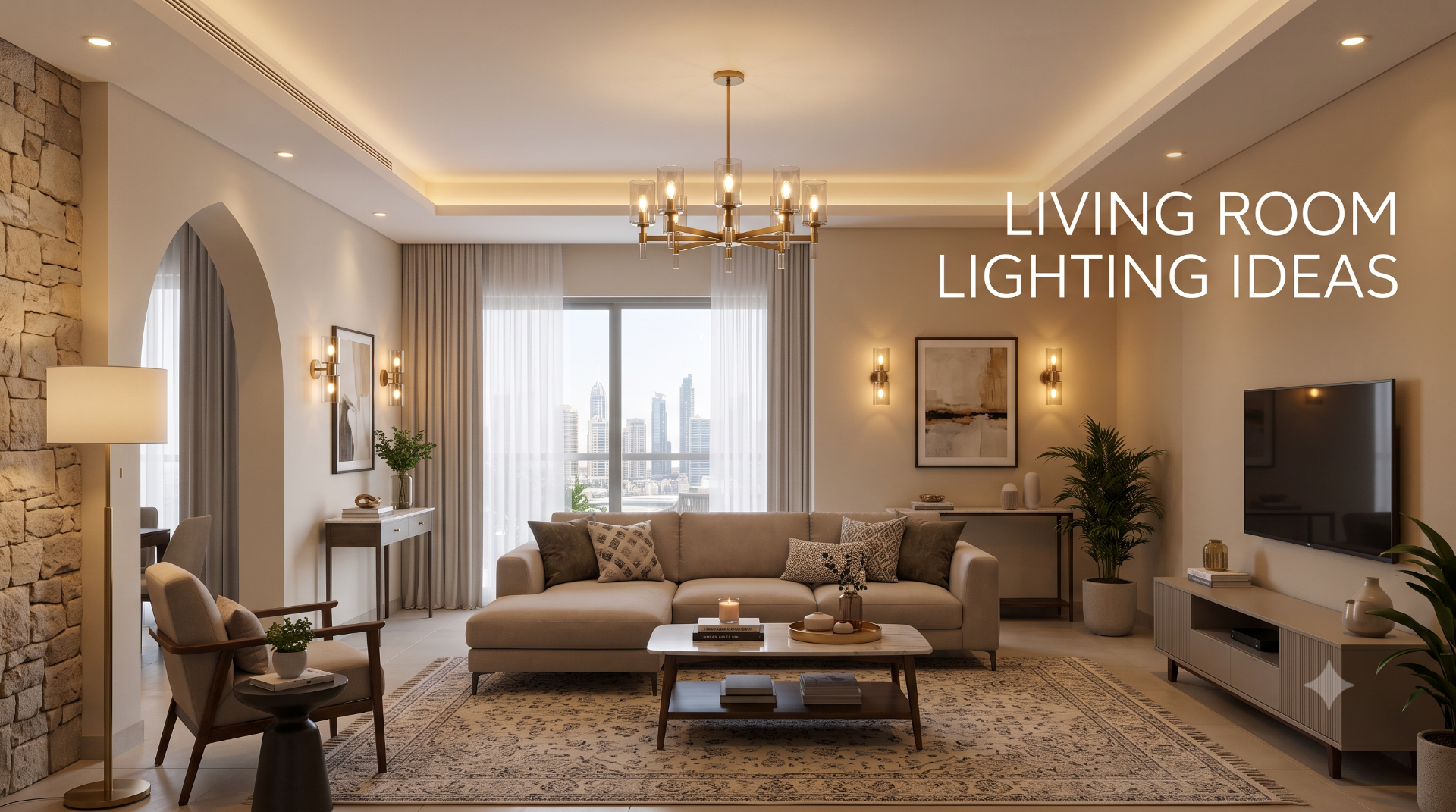
In the UAE, the living room keeps unusual hours. For much of the year, the afternoon sun is strong enough that blinds come down by early afternoon, so the room depends on artificial light even while it is blazing outside. Then evening arrives and the same space becomes the centre of the home. Dinners drift into the lounge, friends drop by after work, and Ramadan and Eid gatherings run well past midnight. One room does several jobs, and its lighting has to handle every one of them.
This is why a single central fitting almost never works, and why a well-planned room feels so different from one that is merely bright. The guide below reflects how living rooms in Dubai apartments, Abu Dhabi villas and Sharjah townhouses are actually used. Each idea explains what it is, why it works, and how to get the details right, from spacing and beam angles to colour temperature and switching. Whether you are renovating or finishing a new home, these living room lighting ideas are meant to be used as a practical planning companion, not just inspiration.
Before You Choose a Single Fitting: Three Questions Worth Answering
Good lighting starts with how you live, not with a product list. Spend ten minutes on these questions before you meet your interior designer or electrician.
What actually happens in this room? List every activity: watching television, reading, hosting guests, children doing homework on the coffee table, prayer, late-night phone calls. Each activity needs a different quality and quantity of light, and the list will tell you where task and accent light are needed.
What is above you? Most UAE homes have gypsum ceilings with a void above them, which makes recessed fittings, coves and linear profiles straightforward. Some apartments have exposed concrete slabs or a very shallow void because of air conditioning ducts, which points towards surface-mounted fittings and track systems.
Where does daylight enter, and when? West-facing living rooms take the harshest afternoon sun and often stay curtained for hours. That changes how you should light walls and curtains, and it matters more here than in most climates.
The Three Layers Every Living Room Needs
Lighting designers think in layers, and the idea is simple.
- Ambient light is the general, even illumination that lets you move around comfortably. For a living room, around 100 to 200 lux suits everyday use.
- Task light is focused light for specific activities such as reading or working on a laptop, typically 300 to 500 lux at the point of use.
- Accent light draws the eye to features such as artwork, a textured wall or a display niche. For an accent to register, it should be roughly three times brighter than its surroundings. Five times reads as dramatic.
Every idea below adds to one of these layers. Combine all three and the room gains depth instead of looking flatly lit.
Ceiling Lighting Ideas
1. Plan a Downlight Layout Around the Furniture, Not the Ceiling
Recessed downlights are the backbone of most UAE living rooms, yet they are also where most mistakes happen. The usual approach is to divide the ceiling into a neat grid and place a fitting at every intersection. It looks tidy on a drawing, but it often puts light directly above people's heads, leaves walls dark and ignores where the sofa, coffee table and TV unit actually sit.
A better method starts with the furniture plan. Mark the seating group, the main walkways and any feature walls first, then place fittings to serve them. Light around the seating rather than over it, so guests are lit softly from the side instead of from straight above, which casts unflattering shadows under the eyes.
For spacing living room ceiling lights, a reliable rule of thumb is to keep fittings roughly as far apart as the ceiling is high, and about half that distance from the walls. On a 3 m ceiling, that means fittings around 3 m apart and 1 to 1.5 m from the walls. Wider beams (around 60 degrees) can be spaced further apart, while narrower beams need closer spacing to avoid dark patches.
One UAE-specific detail is worth checking early. Gypsum ceilings here carry AC diffusers, return grilles, smoke detectors and sometimes sprinkler heads. Ask your contractor for a reflected ceiling plan that shows all of them together, so your lighting layout stays symmetrical and nothing clashes on site.
2. Choose Deep-Recessed, Anti-Glare Downlights
Think about the angle from which you actually see a living room ceiling. Standing, you rarely look up. Leaning back on a sofa, stretched out after a long day or sitting on low majlis-style cushions, you look at the ceiling far more than you realise. From those angles, a standard downlight with an exposed LED source feels like a small, harsh sun.
Anti-glare downlights solve this by setting the light source deeper inside the fitting, often combined with a dark inner reflector or a honeycomb louvre. The result is that you see the light falling on surfaces, such as the floor, the rug and the walls, rather than the bright point that produces it. The room feels calmer even at the same brightness.
When comparing fittings, a few details help:
- Cut-off angle: The deeper the recess, the wider the angle from which the source stays hidden. Deeper is better for seating areas.
- Inner finish: Black or dark inner reflectors make the fitting almost disappear when switched on, while white or silver ones look brighter and more visible.
- Unified Glare Rating (UGR): A lower number means less discomfort glare. It is often quoted for commercial spaces, but it is a useful comparison for homes too.
Jaquar's anti-glare downlights are a sensible starting point for living rooms where the family spends long evenings, because the difference in comfort becomes noticeable after only a few hours.
3. Soften the Ceiling With a Well-Built Cove
Cove lighting is one of the most familiar features of UAE interiors, and done properly it remains one of the most effective. An LED strip hidden in a recessed channel of the gypsum ceiling throws light upwards and across the ceiling surface, producing a soft, indirect glow with no visible source. On a warm evening, the effect is instantly relaxing.
The quality of false ceiling lighting like this depends almost entirely on construction details, so it is worth discussing them before the gypsum work starts:
- Throw distance: Leave at least 250 to 300 mm between the strip and the ceiling above it, so the light has room to spread. Too shallow and you get a bright band with a hard edge.
- Concealment: The strip should be invisible from every seated position in the room. Check sight lines from the sofa, not just from the doorway.
- Continuous light: Use dot-free strips, such as COB strips, so the cove shows a smooth line rather than a row of beads.
- Heat management: Ceiling voids in the UAE can become very hot. Mounting strips in aluminium profiles helps dissipate heat and extends their life.
- Driver access: Plan a discreet access panel for the drivers so future maintenance does not mean cutting into the ceiling.
Paint the inside of the cove white or a pale matt finish. It reflects far more light than a dark or glossy surface, and it keeps the glow even.
4. Add a Shadow Gap for a Floating Ceiling Effect
A shadow gap is a slim recess, usually 20 to 50 mm wide, running around the edge of the ceiling where it meets the wall. On its own, it creates a crisp architectural line. Lit with an LED strip set inside a profile, it makes the whole ceiling appear to float, with a fine thread of light tracing the room's outline.
This detail suits contemporary interiors where you want character without decoration. It is quieter than a traditional cove, takes up less ceiling depth, and looks especially good in apartments where the ceiling height is modest and a deep cove would feel heavy.
A few points help it look intentional:
- Use plaster-in aluminium profiles so the edges stay perfectly straight. Uneven gypsum edges become very visible once lit.
- Keep the light output low. The aim is a line of light, not a source of general illumination.
- Make sure corners are neatly mitred and the strip runs continuously around them, because gaps at corners break the illusion.
- Paint the adjoining wall in a matt finish, since gloss paint reflects the strip as a harsh line.
A shadow gap also works beautifully as a night-time setting. With every other light switched off, the glowing perimeter gives just enough orientation to move through the room, and the space still looks finished rather than dark.
5. Use Linear Profiles for Clean, Architectural Lines
Recessed aluminium profiles with diffused LED strips have become one of the defining features of modern living room lighting. Instead of dots of light scattered across the ceiling, you get continuous lines that can follow the geometry of the room. They give structure to a large ceiling, direct the eye along its length, and reduce visual clutter because a single line replaces several fittings.
The key is to treat the profiles as part of the architecture, not as an afterthought. Align them with something meaningful: the length of the sofa, the centre line of the room, the edge of a rug or the path from the entrance to the terrace doors. Lines that run at random angles or stop short of a wall look accidental.
The diffuser makes a real difference to comfort:
- Opal diffusers give a soft, even line and are ideal where the profile is mainly decorative or part of the ambient layer.
- Microprismatic diffusers control glare better and direct light downwards more efficiently, which helps if the profiles are the main source of ambient light.
Profiles come in recessed, surface-mounted and suspended versions, so the look can carry across rooms with different ceiling conditions. A suspended linear light over a dining table that opens onto the living room is a neat way to tie the two spaces together. Avoid combining too many profiles with too many downlights in the same ceiling. Choose which one leads, and let the other support it quietly.
6. Install a Magnetic Track System for Flexibility
Living rooms change over time. The sofa moves when the family grows, a new painting arrives, a TV gets bigger, or an extra seating group appears for guests during Ramadan. Fixed downlights cannot follow these changes. A magnetic track system can.
A magnetic track is a slim, low-voltage channel into which different light modules simply clip. You can add spotlights to highlight art, linear modules for general light, or small grille lights for a technical look, and then slide or swap them without calling an electrician. The flexibility makes it one of the most future-proof choices for a living room.
To plan one well:
- Route the track to serve the room's key zones. A line parallel to the main wall, a rectangle framing the seating area, or a single run along the room's length all work well.
- Decide between recessed and surface-mounted. A recessed magnetic track sits flush with the gypsum ceiling and almost disappears. Surface versions suit concrete slabs or shallow voids.
- Locate the power feed carefully. The feed point determines where the track starts, so agree on it before the ceiling is closed.
- Leave spare capacity. Choose a driver with some headroom so you can add modules later without replacing it.
Magnetic tracks work particularly well in modern apartments with open-plan living, where one continuous track can move from the lounge to the dining area and adapt to both with different modules.
7. Go Surface-Mounted Where There Is No False Ceiling
Not every UAE home has a gypsum ceiling. Some newer apartments are designed with exposed concrete finishes, and in many older buildings the void above the ceiling is taken up by ducts, leaving no room for recessed fittings. In these homes, surface-mounted lighting is the practical and stylish answer.
Surface-mounted downlights and cylinder lights sit directly on the ceiling. Slim, round or square surface fittings in white blend into a white ceiling and give a quiet, clean result. Cylinder lights in black, graphite or metallic finishes make more of a statement and pair naturally with concrete, dark joinery and industrial-style furniture.
Some practical points to plan for:
- Cable routing: Without a void, cables must be run in surface conduit or chased into the concrete. Discuss this early, as it affects where fittings can go.
- Visual order: Because every fitting is visible, alignment matters more than ever. Line fittings up with walls, windows and furniture so the ceiling looks deliberate.
- Beam choice: Cylinder lights often have narrower beams than recessed downlights. Use them to create pools of light over the coffee table or along a wall, and add wall lights for softer ambient light.
Surface-mounted track systems are another option here. They combine the flexibility of adjustable spots with the simplicity of fixing directly to the slab, which suits renters as well as owners.
8. Light Double-Height Ceilings in Two Tiers
Villas with double-height living rooms are common across the UAE, and they are among the hardest spaces to light well. Fittings mounted 6 or 7 m up must travel a long way to reach the floor, and a room lit only from that height feels distant, a bit like sitting in a hotel lobby rather than at home.
The solution is to light the space in two tiers.
Upper tier: Use downlights or track spots with higher output and narrower beams, around 24 to 36 degrees, so the light reaches the floor with enough intensity. Wider beams spread out too much and lose effect over the distance. The upper tier handles general brightness and can wash the tall walls, which emphasises the room's volume.
Lower tier: Bring light down to human scale with wall lights mounted around 2.2 to 2.5 m high, lit shelving, and accents on artwork at eye level. This tier is what makes the space feel warm and lived in during the evening, when the upper tier can be dimmed or switched off.
Maintenance is the other crucial consideration. Dust is a fact of life in the UAE, and changing or cleaning a fitting 7 m up usually means scaffolding or a tall ladder. Choose quality long-life LED fittings for the upper tier, and ask your contractor how each one will be reached before installation, not after.
Wall and Feature Lighting Ideas
9. Wash a Feature Wall With Even Light
Our eyes judge the size and brightness of a room largely by its walls. A room with bright walls and a modestly lit floor feels more spacious and comfortable than one with a brightly lit floor and dark walls, even when the total light is the same. Wall washing uses this effect to make a room feel larger and calmer.
A wall washer is a fitting designed to spread light evenly from the top of a wall to the bottom, often using asymmetric optics that throw light sideways onto the surface instead of straight down. It suits painted accent walls, patterned wallpaper, large-format marble or porcelain panels and joinery walls.
To achieve a smooth wash:
- Distance from wall: Place fittings about 60 to 90 cm from the wall. Closer and you get bright scallops at the top. Further and the wash becomes weak.
- Spacing: Space fittings roughly as far apart from each other as they are from the wall, which gives overlapping, even coverage.
- Surface finish: Matt and satin surfaces wash beautifully. High-gloss finishes, including polished marble, can show reflections of the fittings, so test on a sample if possible.
- Colour: Warm white brings out warm stone, wood and earthy paint tones, while a neutral white keeps cool greys and whites crisp.
In a UAE living room where curtains are closed for long stretches, a washed wall also replaces some of the brightness normally provided by daylight, which keeps the room feeling open during the afternoon.
10. Graze Textured Surfaces to Bring Out Depth
Grazing is often confused with wall washing, but it does the opposite job. Instead of lighting a wall evenly, grazing places fittings very close to the surface, typically 15 to 30 cm away, so the light skims across it at a steep angle. Every ridge, groove and irregularity casts a tiny shadow, and the texture of the material becomes the main feature.
This technique suits the materials that appear so often in UAE villas and apartments: natural stone cladding, fluted wooden panels, ribbed gypsum, textured plaster, 3D wall tiles and slatted feature walls. A stone wall that looks flat under general light gains real depth when grazed.
How to get it right:
- Choose narrow beams or linear grazers. A row of narrow-beam spotlights gives a rhythmic pattern of light, while a continuous linear grazer produces a smooth, uniform effect along the whole wall.
- Start and stop cleanly. Begin and end the grazing close to the corners of the wall so it looks intentional, and avoid leaving an unlit strip at one end.
- Keep it for suitable surfaces. Grazing reveals everything, including uneven plaster, poorly finished joints and patchy paint. On a smooth wall with imperfections, wall washing is the kinder choice.
A grazed wall behind the TV unit or along the entrance to the living room works especially well, because the texture reads beautifully from across the room and gives the space a focal point without needing decorative fittings.
11. Spotlight Artwork and Calligraphy Properly
A painting, a family photograph or a framed piece of Arabic calligraphy loses much of its presence under general lighting. A dedicated light turns it into a focal point, but only if the angle, beam and colour quality are right.
Angle. The widely used guideline is to aim at the centre of the artwork at about 30 degrees from vertical. This minimises reflections on glass and avoids the frame casting a shadow over the top of the piece. You can work out the position simply. If your ceiling is 2.8 m high and the centre of the artwork is at 1.6 m, the difference is 1.2 m. Multiply that by about 0.58 and you get roughly 0.7 m, which is how far from the wall the spotlight should be.
Beam. A narrow beam of around 24 degrees suits smaller pieces and gives a focused, gallery-like result. Large canvases need wider beams of 36 degrees or more, or two spotlights crossing each other to avoid a hot spot in the middle.
Colour quality. Choose a high colour rendering light so the colours appear as the artist intended. Calligraphy with gold leaf or metallic inks sparkles under a narrow, focused beam, which brings the lettering to life.
Protection. Quality LED fittings emit negligible ultraviolet light, which makes them far kinder to paintings, prints and textiles than older halogen lamps.
Adjustable spotlights on a track or recessed in the ceiling give you the freedom to re-aim when you rearrange or change the art.
12. Use Up-Down Wall Lights Beside Seating
Ceiling fittings light a room from above, which is efficient but can feel impersonal. Wall lights bring light down to eye level, and this single change makes a living room feel noticeably warmer in the evening. Up-down wall lights, which throw light both upwards and downwards, create two soft pools on the wall and add a gentle vertical rhythm.
They work especially well in three places:
- Flanking a sofa, where a pair of wall lights frames the seating and provides soft ambient light for conversation.
- Either side of the TV unit, where they balance the screen and reduce the contrast between the bright TV and the surrounding wall.
- Along long majlis-style walls, where a series of wall lights spaced every 2 to 3 m gives a steady, welcoming rhythm along the seating.
Mounting height matters. Around 1.8 to 2 m from the floor usually works well, high enough to avoid glare for standing people and low enough to feel close and human. The beam angle determines the shape of the pattern on the wall. Narrow beams give sharp, dramatic shapes, while wider beams give softer washes.
Plan wall lights before the walls are finished. Wiring needs to be chased in and the positions confirmed against furniture, because moving a wall light after painting is far more disruptive than moving a ceiling fitting.
13. Backlight the TV Wall to Reduce Eye Strain
Watching a bright screen in a dark room forces your eyes to adjust constantly between the glowing image and the darkness around it. Over a long film or a late-night match, that contrast causes fatigue. A soft light behind the television, known as bias lighting, reduces the contrast and makes viewing far more comfortable.
The simplest way to achieve this is with an LED strip mounted behind a floating TV panel or inside a recessed channel in the TV wall. The light should spill softly around the edges of the screen, not shine directly into the room.
A few guidelines help:
- Keep it gentle. Bias lighting should be much dimmer than the screen. A common guideline from home cinema enthusiasts is around a tenth of the screen's brightness.
- Choose colour to suit your priorities. People who care about picture accuracy often prefer a neutral or daylight tone behind the screen. Most families simply prefer warm white, which matches the rest of the room.
- Leave space. Mount the strip 5 to 10 cm from the wall so the light has room to spread instead of forming a hard line.
- Watch reflections. Downlights directly in front of the screen will reflect on it. Position ceiling fittings to the sides, and light the wall around the TV instead.
Put the TV backlight on its own switch or dimmer channel. It becomes the natural light source for movie nights, with everything else switched off.
14. Light Shelves and Display Niches From Within
Built-in shelving and display niches are a regular feature of UAE living rooms, holding books, ceramics, travel finds, trophies and family heirlooms. Without lighting, they recede into the wall in the evening. Lit from within, they become one of the most characterful parts of the room.
There are two main approaches.
Linear strips along the shelves. Slim LED strips in aluminium profiles mounted along the front edge of each shelf, angled slightly towards the back, light the objects evenly from the front. Mounting them at the front rather than the back avoids silhouetting the objects against a bright wall.
Miniature spotlights in niches. A small recessed spotlight at the top of each niche creates a focused pool of light, perfect for a single vase, a sculpture or a piece of pottery. It gives a more dramatic, gallery-like result.
Some details to consider:
- Colour temperature: Warm white suits wood, leather-bound books and earthy ceramics. A slightly neutral white keeps glass, crystal and silverware crisp.
- Glossy surfaces: Lacquered or glass shelves reflect bare strips. Use profiles with diffusers so the reflection is a soft line rather than a row of dots.
- Drivers: Plan where the drivers will live, ideally in an accessible cabinet or ceiling panel, not sealed behind joinery.
Lit shelving also adds useful ambient light at mid-height, which softens the room and reduces the need for bright ceiling light in the evening.
Hidden and Architectural Lighting Ideas
15. Light the Curtains From a Pelmet
This idea is especially suited to the UAE. Because curtains and blackout blinds stay drawn for long stretches of the day to keep out heat and glare, the window wall often becomes a heavy, dark block. The room loses the sense of openness that daylight normally provides, even though it is sunny outside.
An LED strip hidden in a pelmet or ceiling recess above the curtains solves this by washing the fabric with soft light from above. The curtain becomes a glowing vertical surface, which restores some of the brightness and character of a window during the day and frames the room beautifully at night.
To make it work:
- Position the strip correctly. Mount it inside a recess or pelmet about 150 to 200 mm in front of the curtain track, angled so the light grazes down the fabric.
- Think about the fabric. Sheer curtains glow softly from within and look almost luminous. Heavy blackout curtains show off their folds and texture. Both work, but the effect is different.
- Keep it on a separate circuit. Curtain lighting is useful at very specific times, such as sunny afternoons with curtains drawn and late evenings, so it should be switchable on its own.
- Choose warm tones for evenings. Warm white brings out fabric colours and gives the window wall a welcoming glow.
West-facing living rooms benefit the most. They spend the most time curtained, and a lit window wall balances the room when the harsh afternoon light is shut out.
16. Add a Low-Level Glow With Skirting and Floating Furniture Lighting
Most lighting sits in the ceiling, which leaves the lowest part of the room in shadow. Adding a layer at floor level changes how the space feels, especially at night. It also solves a practical problem: how to move through the room late at night without switching on bright lights.
Skirting lighting. A recessed LED strip in the skirting, or small step lights set into the wall about 20 to 30 cm above the floor, provides a gentle glow along walkways. It is practical for late-night water breaks, for elderly family members, and for early suhoor mornings during Ramadan when the rest of the household is asleep.
Floating furniture. Wall-mounted consoles, floating TV units and built-in benches look lighter when an LED strip runs along their underside. The glow on the floor separates the furniture from the wall and gives the lower part of the room a soft ambient layer.
Two UAE-specific details matter here. First, many homes have polished marble or glossy porcelain floors, which reflect exposed strips as bright mirrored lines. Use deep profiles with diffusers so the source stays hidden and the reflection stays soft. Second, keep this layer very warm and low in output. Around 2200K to 2700K and low brightness gives a calm, restful glow that will not wake anyone at night.
Comfort, Colour and Control
17. Choose the Right Colour Temperature
Colour temperature, measured in Kelvin (K), describes whether light looks warm or cool. It has more influence on how a living room feels than almost any other lighting decision, yet it is often left to chance.
Colour temperature | Appearance | Best use in the living room |
2200K to 2700K | Very warm, candle-like to soft warm | Low-level night lighting, evening ambience |
2700K | Warm white, soft and relaxing | Coves, wall lights, evening ambient light |
3000K | Warm white, slightly crisper | General downlighting, artwork, shelves |
4000K | Neutral white | Study corners, daytime task areas |
6500K | Cool daylight | Generally too clinical for living spaces |
For most UAE living rooms, 2700K to 3000K strikes the right balance. Cool daylight lighting is still common in many homes, often because it seems brighter, but it makes interiors feel like offices and flattens warm materials such as wood, leather and stone. Warmer light in the evening is also easier on the body's natural wind-down rhythm.
Consistency matters as much as the number itself. Two fittings both labelled 3000K can still look slightly different if their colour consistency varies. Ask for fittings with tight colour consistency (often quoted as 3 SDCM or MacAdam steps or less) and try to source all fittings for one room from the same range. Coves, downlights and wall lights then read as one plan rather than a mix of slightly mismatched whites.
18. Consider Tunable White for Day-to-Night Shifts
Tunable white fittings let you adjust the colour temperature, usually between a warm white of around 2700K and a cooler white of 5000K or more. For a room used as much as a UAE living room, this flexibility can make a real difference to comfort through the day.
The rhythm of a typical day shows why. In the afternoon, with blinds drawn against the sun, the room can feel dim and heavy. A slightly cooler, brighter setting keeps it fresh and alert, which suits children doing homework or someone working from home. In the evening, shifting to warm white helps the room and everyone in it wind down. Late at night, the warmest setting at low brightness feels calm and restful.
Tunable white works best when planned from the start:
- Choose which layers need it. Ambient downlights and profiles benefit most. Accent lighting on art usually works better at a fixed colour temperature.
- Plan the controls. Tunable white needs a control method that adjusts both brightness and colour, so discuss this with your electrician early.
- Keep it simple. A few preset scenes, such as daytime, evening and night, are more useful day to day than endless manual adjustment.
Tunable white is not essential for every home, but in rooms that stay curtained for long hours, it is one of the most effective ways to make artificial light feel natural.
19. Make Dimming Part of the Plan
The light level that is perfect for hosting twelve guests at an Eid gathering is far too bright for watching a film with two. Without dimming, you are left choosing between too much light and not enough. Dimmable fittings let one set of lights serve every mood, and they are one of the simplest ways to make a living room feel considered.
Dimming works reliably only when the fitting, the driver and the dimmer are compatible, which is why it needs to be planned rather than added later. The main methods are:
- Phase-cut dimming (leading or trailing edge): Works with standard wall dimmers and suits simple residential installations. Trailing edge is generally preferred for LED fittings because it tends to be smoother and quieter.
- 0 to 10V dimming: Uses a separate control wire and gives smoother results, common in more advanced installations.
- DALI: A digital control system that allows each fitting or group to be controlled individually and supports scenes. It suits larger villas and homes planning automation.
Poorly matched components cause flicker, buzzing, or lights that jump from dim to full brightness. Ask for fittings with confirmed dimming compatibility and test a sample before the full installation.
Also consider how low each fitting can dim. A fitting that dims smoothly down to a very low level is far more useful in the evening than one that switches off abruptly at 20 percent.
20. Split the Room Into Lighting Zones and Scenes
A living room with every light on one switch has only one mood. Dividing the lighting into zones gives you control over what is lit and when, and it transforms how the room can be used.
A typical UAE living room might be divided like this:
- Zone 1: Ambient downlights or profiles over the seating
- Zone 2: Cove or shadow gap
- Zone 3: TV wall backlight
- Zone 4: Feature wall washing or grazing
- Zone 5: Art and shelf lighting
- Zone 6: Curtain and low-level lighting
- Zone 7: Terrace or balcony lighting
Once zones exist, you can combine them into scenes. "Hosting" might bring everything up to full. "Movie night" uses only the TV backlight and low-level glow. "Evening" uses the cove, wall lights and art. "Late night" leaves just the skirting lights.
Label switches clearly, especially in homes with frequent guests, household staff or elderly family members, so anyone can find the right setting. Grouping switches on a neat keypad by the entrance keeps walls tidy.
Even if you do not plan home automation now, wiring each zone on its own circuit leaves the door open. Adding smart control later is simple when the circuits already exist, and very disruptive when they do not.
21. Prioritise High Colour Rendering
Colour Rendering Index (CRI) measures how accurately a light source shows colours compared with natural light, on a scale up to 100. It is one of the most overlooked numbers on a specification sheet, yet it affects everything you see in the room, from the sofa fabric to the rug, the artwork, the wood finishes and the faces of your guests.
When choosing LED lights for living room use, look for a CRI of 90 or higher. Under lower-CRI lighting, colours look muted and slightly grey. Reds and warm tones suffer most, which is why skin can look pale and tired and wooden furniture loses its richness. Under high-CRI lighting, the same room looks noticeably more vibrant, even at the same brightness.
A useful extra detail is the R9 value, which measures how well a light renders saturated reds. It is not always included in the headline CRI figure, but it matters for skin tones, red fabrics, warm woods and many artworks. A strong R9 value is a sign of genuinely good colour quality.
High colour rendering is especially important in three places:
- Artwork and calligraphy lighting, where accurate colour is the whole point
- Seating areas, where people's faces and clothing should look natural
- Rooms with rich textiles, carpets and upholstery
Choosing high-CRI fittings throughout the room, rather than only in selected spots, keeps colours consistent as you move from one zone to another.
Beyond the Room
22. Light the Terrace to Stop Windows Becoming Mirrors
Many UAE living rooms open onto a terrace, balcony or garden through large sliding glass doors. During the day, the view extends the room. At night, if the outside is dark, the glass turns into a black mirror that reflects the room back at you, and the living space suddenly feels enclosed.
The fix is simple: light the outdoor space so the view returns. You do not need much. A few carefully placed fittings are enough to balance the brightness inside and out and reduce the reflection.
- Outdoor wall lights beside the doors or along the terrace wall give a welcoming glow and light the threshold.
- Garden spike lights aimed at planters, palms or shrubs create depth and give the eye something to focus on beyond the glass.
- Downlights in a covered terrace ceiling extend the indoor lighting outwards and make the terrace usable as an outdoor living room.
The UAE climate demands suitable fittings. Choose outdoor lights rated IP65 or higher to keep out dust and moisture, and quality finishes that resist corrosion, particularly in coastal areas such as Dubai Marina, Abu Dhabi Corniche and Ras Al Khaimah, where salty, humid air is hard on metals. Fittings should also be designed to cope with high summer temperatures.
Keep outdoor light warm and moderate so it complements the living room rather than competing with it. A timer or separate switch lets you enjoy the terrace view on cooler evenings without leaving it lit all night.
Matching the Plan to Your Room
Small apartment living rooms (under 20 sq m): Focus on vertical surfaces. Wall washing, lit shelves and curtain lighting make compact rooms feel larger than a crowded ceiling of downlights does. Keep fittings slim and few, and consider a shadow gap instead of a deep cove to preserve ceiling height.
Medium living rooms (20 to 40 sq m): Layering pays off most here. Combine a furniture-led downlight layout with a cove or profile, one accent feature, a TV backlight and at least three switching zones.
Large villa living rooms and majlis spaces: Divide the space into zones with their own lighting character. Linear profiles or magnetic tracks help structure large ceilings, and wall lights keep the scale comfortable. In double-height rooms, always plan the two-tier approach.
Open-plan living and dining: Use lighting to mark the transition. A change in fitting type or ceiling treatment over the dining zone defines each area without walls.
Energy and heat: In a climate where air conditioning runs for most of the year, lighting choices affect cooling. Older halogen and incandescent lamps turn most of their energy into heat, which the AC then has to remove. Quality LED fittings use a fraction of the energy and give off far less heat, helping both comfort and utility bills.
Common Mistakes Worth Avoiding
- Too many downlights: Dozens of identical fittings produce a flat, airport-like feel. Fewer, better-placed lights with accents look far more considered.
- Mixed colour temperatures: Warm coves with cool downlights in the same view looks unplanned. Keep one colour family per room.
- Lighting only the floor: Lit walls and ceilings shape how large and comfortable a room feels.
- Forgetting maintenance access: Fittings in double-height ceilings and drivers sealed behind gypsum become expensive problems later.
- One switch for everything: Beautiful fittings on a single circuit give you only one mood.
Conclusion
The best living rooms rarely rely on one spectacular fitting. They rely on a thoughtful mix of layers: even ambient light, focused light where you read or work, and accents that give the eye somewhere to rest. In the UAE, where the room shifts between sun-shielded afternoons and long, sociable evenings, that flexibility matters even more. Start with how you use the space, choose warm and accurate light, plan your zones before the ceiling is closed, and you will have a living room that feels right at every hour.
Jaquar's lighting range spans downlights, track and magnetic systems, profiles, strips, and wall and outdoor fittings, which makes it easier to build every layer of a living room from one consistent source. Consistent colour quality across fittings means your coves, spots and wall lights read as one plan rather than a collection of parts.
Frequently Asked Questions
- How many downlights do I need for a living room? It depends on room size, ceiling height and beam angle, but a common starting point is to space fittings roughly as far apart as the ceiling is high. A 4 m by 5 m room with a 3 m ceiling typically needs six to eight downlights for ambient light, supported by accent and wall lighting rather than more downlights.
- What colour temperature is best for a living room in the UAE? Warm white between 2700K and 3000K suits most living rooms and creates a relaxed atmosphere in the evening. Tunable white fittings are worth considering if you want a slightly cooler, fresher setting during the day when blinds are drawn against the sun.
- Is cove lighting still a good choice for modern interiors? Yes, when it is built well. A continuous, dot-free LED strip hidden in a well-proportioned cove gives soft indirect light that suits both contemporary and classic interiors. Pair it with linear profiles or shadow gaps for a more current look.
- How do I light a TV wall without glare? Place a soft backlight behind the television to reduce eye strain, and avoid downlights directly in front of the screen where they cause reflections. Grazing or washing the wall around the TV unit adds interest without competing with the screen.
- Which outdoor lights suit UAE balconies and terraces? Choose fittings rated IP65 or higher with corrosion-resistant finishes so they can withstand dust, heat and coastal humidity. Wall lights near the doors and spike lights among planters are a simple combination that lights the space and stops glass doors from reflecting the room at night.