


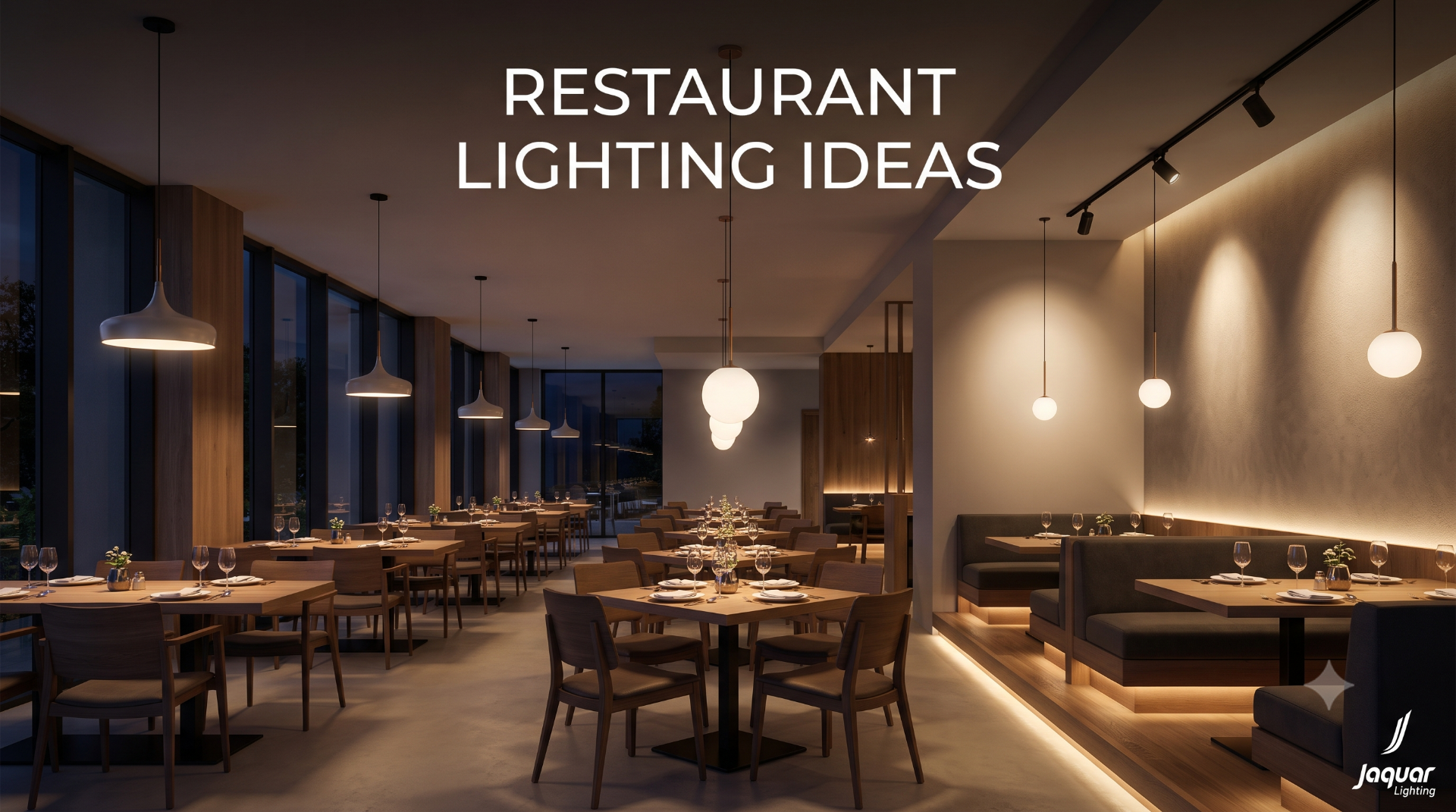
A restaurant is experienced through more than its menu. Before the first dish arrives, guests notice the atmosphere, the comfort of the seating, the character of the interiors and, often without consciously realising it, the way the space is illuminated. Lighting influences how a dining room feels, how clearly guests see their food, how architectural details are perceived and how the overall environment changes from daytime service to evening dining.
That makes restaurant lighting ideas an important part of hospitality design rather than a finishing detail added after the interiors are complete.
In the UAE, restaurants operate across a wide variety of settings, from compact cafés and contemporary casual dining spaces to large restaurants with terraces and more formal dining rooms. Each setting needs a lighting approach that responds to its size, layout, ceiling height, seating arrangement and desired atmosphere.
A well-designed scheme does not necessarily mean using more lights. It means using different types of illumination thoughtfully, so that general visibility, dining comfort and visual character work together.
Why Lighting Matters in a Restaurant
Good restaurant lighting has several jobs to perform simultaneously.
First, it needs to provide enough illumination for guests and staff to move comfortably through the space. Tables, circulation paths, counters and service areas should be visually clear without making the restaurant feel overly bright.
Second, lighting contributes to the atmosphere. A relaxed dining room usually benefits from a softer visual environment than a fast-paced café, while a contemporary restaurant may use stronger architectural definition to give the interior a more structured appearance.
Third, lighting helps establish hierarchy. Not every part of a restaurant needs the same visual emphasis. A feature wall, dining table, entrance, bar counter or architectural element can be given more attention while secondary areas remain visually quieter.
Finally, lighting needs to remain comfortable over the entire dining period. Glare, harsh contrasts and poorly positioned fixtures can become distracting when guests are sitting under them for an extended time.
The objective, therefore, is not simply brightness. It is balance.
1. Build the Foundation with Ambient Lighting
Ambient lighting provides the basic illumination of the restaurant. It establishes the overall brightness level and allows guests and staff to navigate the space comfortably.
For larger dining rooms, recessed lighting can provide a clean foundation without competing heavily with the furniture and interior architecture. Surface lighting can also work well where the ceiling design does not accommodate recessed fixtures.
The important point is consistency. A restaurant with very bright areas beside noticeably dark zones can feel visually disconnected. The lighting should support the floor plan rather than follow an arbitrary grid.
For example, seating areas may require a softer visual environment, while circulation paths can remain clearer. The lighting layout should follow these functional differences.
Jaquar’s indoor lighting portfolio includes recessed, surface, linear, track and general lighting solutions, giving designers different ways to establish this foundation depending on the restaurant's architecture.
2. Use Pendant Lights Above Dining Tables
Pendant lights are particularly effective when individual dining tables or table clusters need visual definition.
Suspending a fixture above a table naturally establishes that table as a focal point. It can also help create a sense of intimacy without physically separating one seating area from another.
In a restaurant with a long communal table, a series of hanging fixtures can reinforce the length of the furniture and create rhythm along the ceiling. In smaller restaurants, one or more carefully selected pendants can provide a visual anchor without requiring extensive decorative treatment elsewhere.
The scale is important.
A pendant that is too large can dominate the table and obstruct the visual openness of the room. One that is too small may disappear within a larger interior. The height of the ceiling, dimensions of the table and distance between fixtures should all be considered together.
Jaquar offers hanging and pendant lighting within its lighting range, allowing decorative fixtures to become part of the restaurant's interior language rather than functioning only as sources of illumination.
3. Create a More Intimate Dining Atmosphere
Restaurants often need to feel comfortable rather than clinically bright, particularly during evening service.
One effective approach is to keep the overall ambient illumination controlled while allowing selected areas to receive greater visual emphasis. Dining tables, decorative walls and architectural features can then become naturally prominent.
Wall lamps can support this approach. Positioned along walls or within selected seating zones, they add illumination at eye level and introduce another layer into the lighting composition.
This is particularly useful in restaurants where the walls have material, texture or decorative detailing that would otherwise disappear in uniform overhead lighting.
The aim is not to make every surface equally bright. A little variation creates depth.
4. Highlight Architectural Features with Accent Lighting
Restaurants frequently contain elements worth highlighting: textured walls, partitions, columns, artwork, display shelves or distinctive architectural forms.
Track lighting can be useful when the direction of illumination needs flexibility. Individual lights can be positioned toward selected features rather than illuminating the entire room uniformly.
Recessed or other focused indoor fixtures can also be used where a more integrated appearance is preferred.
Accent lighting should remain selective. If everything receives the same emphasis, nothing becomes a focal point.
A useful way to approach the layout is to identify the three or four elements guests should notice first and then decide where additional illumination is actually necessary.
5. Give Small Restaurants a Sense of Structure
Smaller restaurants face a different challenge. There may not be enough physical space for extensive lighting layers, yet the lighting still needs to make the interior feel intentional.
A combination of recessed or surface lighting with a few decorative fixtures can provide both functionality and personality.
For a compact café, hanging lights above the primary seating area can create a clear focal zone while keeping the rest of the ceiling visually simple.
Wall lamps can also make narrow spaces feel more layered without occupying valuable floor area.
The key is restraint. Too many decorative fixtures in a small restaurant can make the ceiling and walls visually busy. A smaller number of well-positioned fixtures usually creates a stronger result.
6. Make Long Dining Rooms Feel More Balanced
Long restaurants can sometimes feel visually stretched, especially when the ceiling and furniture run continuously from one end to the other.
Lighting can help divide the space into comfortable visual zones.
Pendant lights placed above different seating clusters can establish a rhythm. Linear lighting can reinforce architectural lines, while track lighting can bring attention to selected areas.
Another useful approach is to vary the emphasis between zones. The entrance can have its own visual identity, the central dining area can remain comfortable and balanced, and a feature wall or private seating section can receive additional accent illumination.
This creates progression through the restaurant without requiring physical partitions.
7. Use Decorative Lighting as Part of the Interior Design
Decorative lighting should not be treated as an afterthought.
Chandeliers, pendants, floor lamps and wall lamps can contribute to the visual identity of a restaurant even when they are not responsible for the majority of its illumination.
For a restaurant with a strong design concept, decorative fixtures can echo materials, shapes or finishes already used in furniture and interiors.
The important principle is coherence.
A contemporary restaurant does not necessarily need an elaborate decorative fixture. A simple pendant repeated consistently can have more impact than several unrelated statement pieces.
Similarly, a more expressive restaurant interior can use chandeliers or decorative wall lighting as part of its overall composition.
Jaquar's decorative lighting range includes chandeliers, pendants, floor lamps, table lamps and wall lamps, providing options for restaurants that want decorative elements to contribute to the atmosphere.
8. Treat Outdoor Dining as an Extension of the Restaurant
Many UAE restaurants make use of outdoor seating, terraces and landscaped dining areas. These spaces should not feel like an entirely separate environment after sunset.
Outdoor lighting can help connect the exterior with the restaurant's interior character.
Wall-mounted fixtures can define boundaries and vertical surfaces. Surface lighting can support functional areas, while selected outdoor fixtures can provide illumination around pathways and seating zones.
The goal should be comfortable visibility rather than excessive brightness.
A terrace with every surface brightly illuminated can lose the relaxed quality that makes outdoor dining appealing. A more controlled approach allows seating areas and architectural features to remain visible while maintaining a calmer atmosphere.
Jaquar's outdoor lighting portfolio includes solutions for different exterior applications, making it possible to treat outdoor dining as part of the wider lighting scheme rather than as an isolated requirement.
9. Think About Day-to-Night Transitions
A restaurant rarely operates under the same lighting conditions throughout the day.
During daylight hours, natural light may provide a substantial portion of the illumination. As evening approaches, artificial lighting gradually becomes more important.
This transition should be considered when planning the lighting layout.
A restaurant with large windows may need a different approach from an enclosed dining room. Similarly, a terrace exposed to daylight requires a different evening strategy from an interior dining area.
Where suitable control options are available, the lighting environment can be adjusted to suit the changing conditions rather than maintaining one fixed level throughout the day.
This is particularly valuable for restaurants with breakfast, lunch and dinner service because each period can require a different visual character.
10. Choose Colour Temperature with the Dining Experience in Mind
Colour temperature affects how a restaurant feels.
Warmer light generally creates a more relaxed and intimate atmosphere, while neutral or cooler illumination can provide a cleaner and more energetic appearance.
There is no single colour temperature that is right for every restaurant.
A casual café may have a different requirement from a family restaurant or contemporary dining space. The materials used in the interior also matter. Wood, stone, metal, upholstery and wall colours can all respond differently to light.
Consistency is important as well. Mixing noticeably different colour temperatures without a design reason can make the restaurant feel visually fragmented.
Rather than selecting lighting based only on fixture appearance, consider how the light interacts with the entire interior.
11. Consider the Size and Height of the Restaurant
The dimensions of the space should influence fixture selection.
Low ceilings generally benefit from fixtures that preserve headroom and maintain visual openness. Higher ceilings provide more flexibility for hanging fixtures and larger decorative elements.
In a compact restaurant, recessed or surface fixtures may provide the necessary illumination without making the ceiling feel crowded.
In a large dining room, pendant lighting or chandeliers can help fill vertical space and create visual scale.
The size of the fixture should always relate to the space around it. A beautiful fixture can still look out of place when its proportions are not compatible with the room.
12. Lighting for Different Restaurant Zones
A restaurant is rarely one uniform space.
Entrance
The entrance should be easy to identify and visually welcoming. Lighting can establish the transition between the exterior and dining area without overwhelming guests as they enter.
Main Dining Area
The main dining area requires the most careful balance between visibility and ambience. Guests should be able to see their food and companions comfortably while the space retains its intended character.
Private Dining
Private dining areas can use more concentrated lighting and decorative fixtures to create a stronger sense of separation from the main restaurant.
Counter or Service Area
Where customers interact with staff, slightly clearer illumination can improve visibility and make the space easier to navigate.
Outdoor Seating
Outdoor areas need enough illumination for comfortable movement while maintaining the atmosphere that makes terrace dining appealing.
Thinking in zones helps avoid the common mistake of giving every part of the restaurant the same lighting treatment.
13. Common Restaurant Lighting Mistakes to Avoid
Even good fixtures can produce poor results when they are used without considering the complete space.
Over-lighting the entire room: Excessive brightness can remove depth and make the restaurant feel more functional than atmospheric.
Ignoring glare: A fixture positioned directly in a guest's field of view can become uncomfortable during a long meal.
Using too many fixture styles: Mixing unrelated designs can make the interior feel visually inconsistent.
Forgetting the walls: Relying entirely on ceiling lighting can leave vertical surfaces flat and uninteresting.
Choosing fixtures before planning the layout: Lighting should respond to furniture, circulation and architecture rather than being positioned independently.
Treating outdoor areas separately: A terrace should feel connected to the restaurant instead of appearing as an unrelated illuminated zone.
14. How to Choose the Right Lighting Approach
Start with the restaurant's purpose.
Ask how guests are expected to feel when they enter. Is the experience relaxed, energetic, social, contemporary or intimate?
Next, study architecture.
Look at ceiling height, table arrangement, wall surfaces, entrances, windows and outdoor areas. These characteristics determine where different lighting types can work effectively.
Then divide the restaurant into zones.
Identify where general illumination is required, where guests spend the most time and which architectural or decorative features deserve additional attention.
Finally, select fixtures.
Recessed and surface lighting can provide the foundation. Pendants and chandeliers can introduce character. Wall lamps can create vertical layers. Track and focused lighting can highlight selected features, while outdoor fixtures can extend the experience beyond the main dining room.
This sequence keeps the design process practical and prevents the fixture from dictating the entire lighting scheme.
Conclusion
Successful restaurant lighting is less about making a space brighter and more about making it feel considered. The best schemes balance visibility with atmosphere, give different zones their own identity and use light to support the architecture rather than compete with it.
For UAE restaurants, the combination of indoor, decorative and outdoor lighting can create a cohesive experience from entrance to dining table and, where applicable, terrace. The most effective approach is one that reflects the restaurant's concept, physical dimensions and daily rhythm while remaining comfortable for guests.
Jaquar lighting solutions can support this approach through a broad selection of indoor, decorative and outdoor fixtures designed for different spatial applications. A considered range also makes it easier to maintain visual consistency when multiple lighting types are required across one hospitality project.
FAQs
- What type of lighting is best for a restaurant?
A combination of ambient, accent and decorative lighting usually works better than relying on one fixture type. Recessed, surface, pendant, wall and focused lighting can be combined according to the restaurant's layout. - How can lighting make a restaurant feel more inviting?
Controlled illumination, comfortable brightness, selected accent areas and decorative fixtures can create depth and a more relaxed atmosphere without making the restaurant excessively dark. - Are pendant lights suitable for restaurants?
Yes. Pendant lights work particularly well above dining tables, counters and communal seating because they provide visual focus while contributing to the interior design. - How should outdoor restaurant areas be illuminated?
Outdoor dining should have enough light for comfortable movement and seating while avoiding excessive brightness. Outdoor wall, surface and area lighting can be selected according to the space and architecture. - Should all restaurant lights have the same colour temperature?
Consistency is generally preferable within connected areas, but different zones can have different requirements. The final selection should consider the restaurant's ambience, materials, natural light and operating hours.