


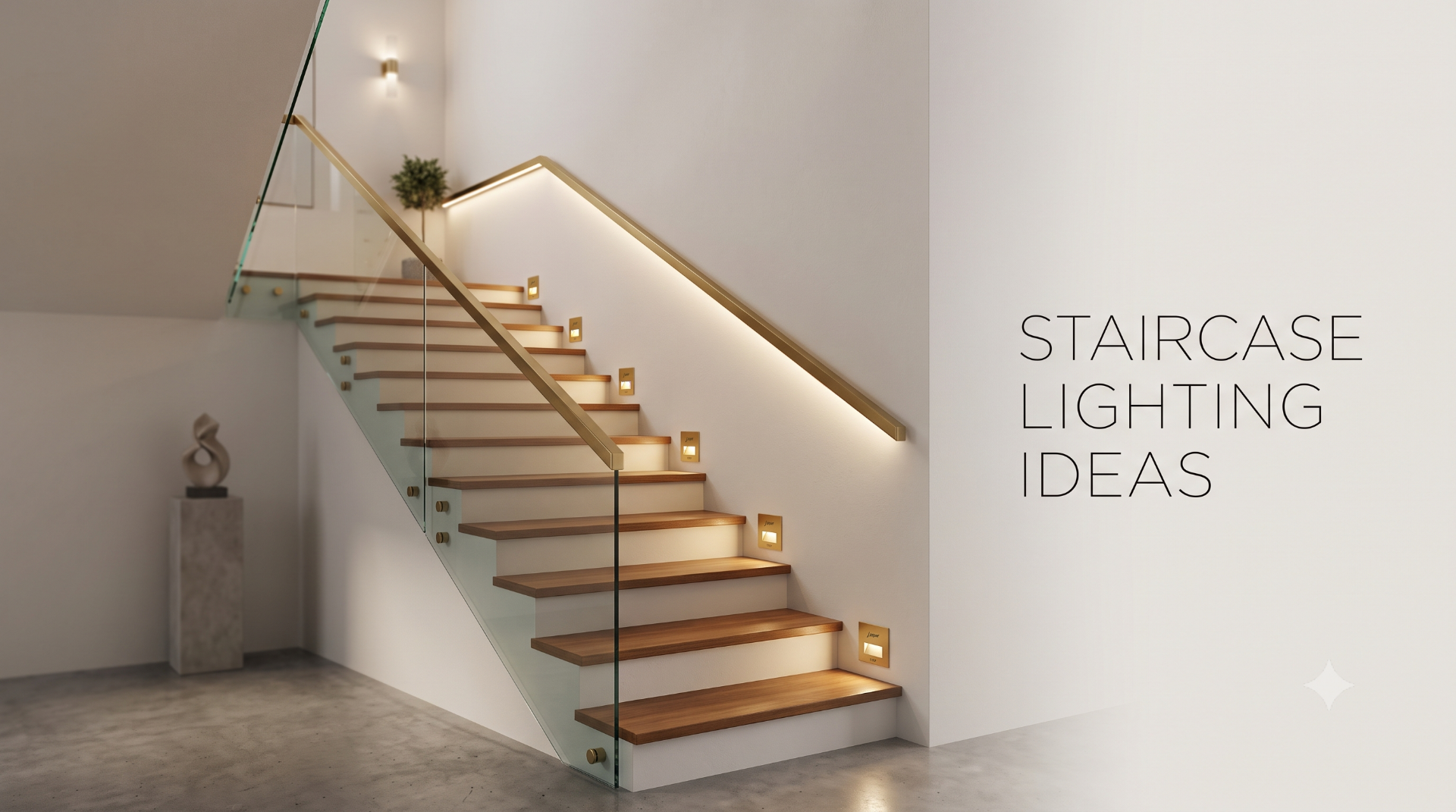
A staircase is one of the most architectural parts of a home. It connects levels, creates movement through the interior and often becomes one of the first features people notice when entering a house. Yet staircase lighting is frequently treated as an afterthought, with a single ceiling fixture expected to illuminate every step.
Good staircase lighting works differently. It helps people see each step clearly, reduces harsh shadows, gives the staircase visual depth and allows an otherwise overlooked transition area to become part of the home's overall lighting design.
Whether the staircase is compact, open-riser, straight, L-shaped or positioned against a feature wall, the right lighting approach depends on its structure, surrounding surfaces, natural light and how the space is used after dark.
This guide explores practical staircase lighting ideas for contemporary homes, explains the different ways stair lights can be positioned, and shows how to select lighting that balances visibility, comfort and aesthetics without making the staircase feel over-designed.
Why Staircase Lighting Matters
Stairs present a different lighting challenge from a normal room.
A living room can rely on broad ambient illumination. A staircase needs enough light at different levels so that changes in height, tread depth and direction remain visually clear.
Poorly positioned lighting can create deep shadows across the tread, produce glare when someone approaches the staircase or leave the lower and upper sections noticeably darker than the middle.
Well-planned lighting addresses three things simultaneously:
- Visibility: Each step should be easy to identify.
- Comfort: Light should not shine directly into the eyes of someone walking up or down.
- Visual continuity: The staircase should feel connected to the lighting scheme of the surrounding space.
This does not mean every staircase needs numerous fixtures. In many homes, a small number of carefully positioned stair lights can achieve more than a large, bright fitting placed in the wrong location.
Jaquar's UAE portfolio includes dedicated LED foot and stair lights, along with indoor, decorative and ceiling lighting options that can be considered when planning the wider staircase environment.
1. Recessed Step Lighting for a Clean Architectural Look
Recessed stair lights are among the most effective solutions when the staircase is being designed or renovated with lighting in mind.
The fixture sits within the wall or stair structure, allowing the light source to remain visually discreet while directing illumination toward the walking surface.
This approach works particularly well with:
- Contemporary staircases
- Straight staircases
- Staircases with a solid side wall
- Minimal interiors
- Homes where the staircase itself is intended to remain visually uncluttered
The important consideration is positioning. A light should illuminate the tread rather than become the main visual feature of the wall.
For a modern staircase, a restrained row of recessed foot lights can create a clear rhythm as the steps rise. During the day, the fixtures can remain visually quiet; after dark, they provide a practical layer of illumination.
2. LED Foot Lights for Individual Steps
A dedicated foot light is useful when the objective is to create localised illumination close to the staircase.
Instead of attempting to illuminate the entire stairwell from above, foot lights bring light closer to the level where it is actually needed.
This is particularly useful on:
- Long staircases
- Staircases with darker finishes
- Internal staircases with limited natural light
- Stairs leading toward bedrooms or private areas
- Homes where low-level lighting is preferred at night
Jaquar UAE currently lists LED Foot Light and Foot Light options within its dedicated stair-light category.
The key is consistency. If foot lights are used, keeping their placement visually regular generally creates a more composed result than installing them randomly wherever additional brightness seems necessary.
3. Wall Lighting Along the Staircase
Not every staircase requires lighting directly on every step.
Where there is a suitable wall alongside the staircase, wall-mounted lighting can provide a softer layer while also contributing to the interior's decorative character.
Wall lamps can work especially well when the staircase forms part of an entrance hall, living area or open-plan space.
The fixture should not sit at a height or angle that creates direct glare for people climbing the stairs. Light distribution is more important than simply selecting the brightest fixture.
Jaquar UAE's lighting portfolio includes wall lamps in several designs and finishes, giving homeowners an option for coordinating staircase illumination with other decorative lighting in the home.
A wall lamp can also be useful when the staircase wall is itself an architectural feature. Instead of treating the wall as empty space, the lighting can give it purpose without overwhelming it.
4. Downlights for the Stairwell
Downlights are another practical option when the staircase has a ceiling, landing or adjacent false-ceiling structure that allows recessed or surface lighting.
They can provide general illumination to the staircase rather than concentrating light on individual steps.
However, downlights should not be relied upon as the only source of illumination on a staircase if they create strong shadows.
A better approach is often to combine broad overhead illumination with low-level stair lighting.
For example:
Overhead lighting + step lighting = general visibility + step definition
This layered approach can be particularly useful in a large staircase where a single row of fixtures cannot illuminate the entire vertical space evenly.
Jaquar UAE offers multiple indoor downlight and indoor lighting options, including recessed and surface solutions.
5. Lighting a Double-Height Staircase
Double-height staircases need a slightly different strategy.
Because the vertical distance between the staircase and ceiling can be substantial, a single ceiling fitting may leave the lower steps inadequately illuminated.
The staircase should instead be considered in layers.
A useful arrangement can include:
- Low-level stair or foot lights for the steps.
- General ceiling illumination for the stairwell.
- Decorative lighting where the architecture allows it.
- Additional lighting at the landing or transition points.
The objective is not to make every part equally bright. It is to create enough visual information for movement while preserving the sense of height that makes a double-height staircase attractive.
If a pendant is used in the surrounding space, its size and hanging position should also be considered carefully so that it does not interfere with the visual or physical movement around the staircase.
Jaquar's UAE ceiling-light portfolio includes pendant and ceiling lighting options that can be used within broader interior lighting schemes.
6. Lighting a Narrow Staircase
Narrow staircases require restraint.
Too many fixtures can make the staircase feel busy, while overly powerful lighting can make the surrounding walls appear harsh.
Low-level lighting is often useful because it directs attention toward the steps without requiring large fixtures.
For a narrow staircase:
- Keep the fixture profile visually discreet.
- Avoid placing lights directly at eye level.
- Maintain consistent spacing.
- Use the wall as a reflective surface where appropriate.
- Avoid creating alternating bright and dark patches.
If the staircase connects bedrooms to the upper floor, a softer night-time lighting layer can also be more comfortable than switching on the home's full ambient lighting.
7. Lighting an Open-Riser Staircase
Open-riser stairs introduce another consideration: light can pass between the treads.
This creates an opportunity to use light as part of the staircase's visual structure, but it also means glare can become more noticeable.
Instead of directing a strong light straight toward the open risers, consider lighting from the side or using controlled low-level illumination.
The lighting should reveal the relationship between the treads without turning the underside of the staircase into a bright visual distraction.
For open-riser designs, simplicity generally works better. The staircase already has visual openness, so the lighting can remain comparatively quiet.
8. Staircase Lighting for L-Shaped and U-Shaped Stairs
A staircase that changes direction needs special attention at the landing.
Someone approaching the turn should be able to see the transition clearly.
For L-shaped and U-shaped staircases, think of the installation as a sequence of zones:
Lower flight → landing → upper flight
Each section should feel connected rather than independently lit.
The landing is especially important because it is where direction changes. If the landing is noticeably darker than the flights, the transition can feel abrupt.
A wall light, ceiling fixture or appropriately positioned stair light can help maintain visual continuity.
9. Use Light to Highlight Materials
Staircase materials have a major influence on how lighting appears.
Wood can absorb and soften illumination. Stone and tile can reflect more light. Glass can introduce reflections and transparency. Dark surfaces can make a staircase feel visually heavier, while lighter surfaces can distribute light more broadly.
This means the same lighting arrangement can look completely different depending on the staircase finish.
Before finalising the installation, consider how light interacts with:
- Treads
- Risers
- Handrails
- Side walls
- Flooring
- Glass balustrades
- Feature walls
The best result is not necessarily the brightest staircase. It is the one where the lighting works with the materials already present.
10. Create a Night-Time Lighting Layer
One of the most useful approaches in residential staircase design is to separate everyday lighting from night-time lighting.
During the evening, the entire surrounding area may be illuminated. Later at night, there may be no need to switch on all the room lights simply to walk downstairs.
Low-level stair lighting can provide a practical alternative.
This is especially relevant for:
- Homes with bedrooms upstairs
- Duplex apartments
- Family homes
- Guest areas
- Staircases connecting private and common spaces
A dedicated stair-light layer also helps preserve the atmosphere of adjoining rooms.
11. Don't Make Every Stair Bright
A common mistake is assuming that more brightness automatically means better staircase lighting.
It doesn't.
The eye needs contrast to understand the shape of the stairs. Excessive brightness can flatten the visual relationship between the tread and riser, while uncontrolled glare can make walking less comfortable.
The objective should be clear visibility rather than maximum brightness.
This is one reason small, strategically positioned fixtures can often outperform a single high-output fixture.
12. Coordinate Stair Lighting With the Rest of the Home
The staircase should not look like a separate lighting project.
If the living room uses warm decorative lighting, introducing an unrelated lighting character on the staircase can make the transition feel disconnected.
Similarly, if the surrounding interiors use clean recessed lighting, a highly decorative staircase fixture may become visually dominant.
Look at the lighting scheme as a whole:
- Living room
- Entrance
- Corridor
- Staircase
- Upper landing
- Adjacent bedrooms
The staircase sits between these areas, so it can act as a visual bridge.
13. Choose the Right Colour Temperature
Colour temperature affects the atmosphere created by a staircase.
Warm lighting can create a softer, more residential feeling and work particularly well with wood, warm neutral walls and relaxed interiors.
Neutral lighting can provide a balanced appearance where clarity is important.
Cooler lighting may suit more contemporary environments, particularly where the surrounding interior already uses cooler finishes.
There is no universal rule that one colour temperature is correct for every staircase. The surrounding lighting, materials and personal preference should guide the decision.
Most importantly, avoid mixing noticeably different colour temperatures on the same staircase unless the contrast is intentional.
14. Staircase Lighting for Modern UAE Homes
Residential interiors across the UAE can vary significantly, from compact apartments to large villas with open-plan layouts and double-height entrances.
That variety means staircase lighting should be designed around the architecture rather than following a single trend.
For a compact apartment, discreet foot lights or recessed solutions can preserve floor and wall space.
For a larger villa, staircase lighting can become part of a broader architectural composition, combining step illumination with ceiling, wall or decorative lighting.
In both cases, the principle remains the same: illuminate movement first and use decorative lighting to support the architecture rather than compete with it.
15. Common Staircase Lighting Mistakes
Installing one bright light at the top
This can leave sections of the staircase unevenly illuminated.
Placing lights directly at eye level
A fixture can be visually uncomfortable if people walking up the stairs see the light source directly.
Ignoring the landing
A staircase is not just a sequence of steps. Changes in direction need clear illumination too.
Using inconsistent spacing
Irregular fixture placement can make an otherwise well-designed staircase look unfinished.
Choosing fixtures only for appearance
A beautiful fixture still needs to provide appropriate light for its location.
Mixing incompatible colour temperatures
Different lighting tones can make the staircase and adjoining spaces feel disconnected.
Staircase Lighting Selection Checklist
Before finalising the design, ask:
Question | Why it matters |
Is the staircase naturally bright during the day? | Determines how much artificial lighting is needed |
Is there a wall beside the stairs? | Creates opportunities for recessed or wall lighting |
Is the staircase open or enclosed? | Influences glare and light distribution |
Where does the staircase change direction? | Helps identify landing lighting requirements |
What materials are being used? | Affects reflection and visual appearance |
Is night-time movement important? | May justify a separate low-level lighting layer |
What lighting is used nearby? | Helps maintain visual consistency |
Are fixtures visible from the main living space? | Important for overall interior composition |
Frequently Asked Questions
1. What is the best lighting for a staircase?
The most suitable lighting depends on the staircase design. Recessed stair lights, foot lights, wall lighting and appropriately positioned ceiling or downlights can all work effectively when selected according to the structure.
2. Are stair lights useful even when a staircase already has ceiling lighting?
Yes. Ceiling lighting can illuminate the overall stairwell, while low-level stair lighting helps define individual steps and reduce dark areas.
3. Should stair lights be installed on every step?
Not necessarily. The number and placement depend on the fixture, staircase dimensions, surrounding illumination and desired visual effect. Consistent illumination is more important than simply maximising the number of fixtures.
4. What colour of light is suitable for staircase lighting?
Warm, neutral or cooler light can work depending on the surrounding interior. The best choice should complement the home's existing lighting and materials while providing comfortable visibility.
5. Can staircase lighting be used as a decorative feature?
Yes. Stair lighting can highlight architectural lines, wall textures, materials and changes in level while still serving its primary purpose of improving visibility.
Conclusion
A well-lit staircase does not need to dominate an interior. The strongest designs usually work quietly in the background, making every step easier to read while adding depth and continuity to the surrounding architecture.
Start with the structure of the staircase, understand where shadows and dark areas occur, then select the lighting method that solves those specific requirements. Recessed stair lights and foot lights can provide focused illumination, while wall, ceiling and indoor lighting can complete the wider composition.
Jaquar's lighting portfolio provides dedicated stair-lighting solutions alongside indoor, decorative, ceiling and wall-lighting categories, allowing staircase illumination to be considered as part of a coordinated lighting scheme rather than an isolated fixture choice.
The benefit of choosing Jaquar lighting is the ability to work with a considered range of lighting formats, finishes and applications while keeping functionality central to the design. For staircase projects, that balance can help create lighting that remains useful every day while fitting naturally into the character of the home.