


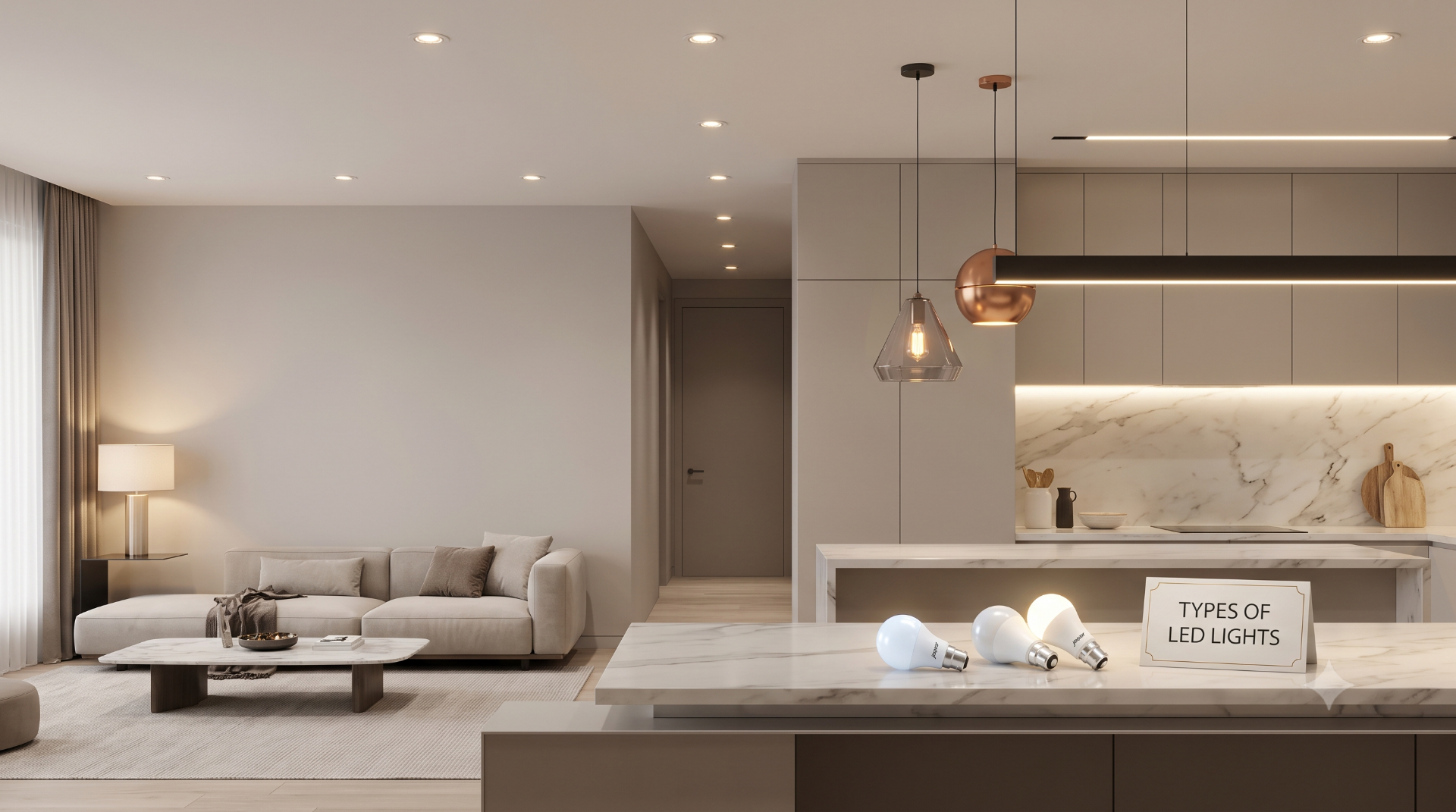
Lighting has moved well beyond the simple task of making a room visible. Today, the right light can define how a space is used, draw attention to architectural details, improve everyday comfort and create a distinct atmosphere from morning to evening.
LED technology has made that flexibility easier to achieve. Instead of relying on one fixture throughout a room, homeowners can combine different lighting formats according to the purpose of each area. A living room may benefit from broad, comfortable illumination with selected accent points, while a kitchen needs clearer task lighting. A bedroom may need a softer combination, whereas a home office requires consistent illumination for focused work.
Understanding the different types of LED lights is therefore less about memorising product categories and more about knowing what each format does best.
Jaquar's UAE lighting portfolio includes solutions across indoor, decorative and outdoor applications, with categories such as LED panels, downlights, bulbs, battens, strip lights, linear lighting, magnetic lighting and decorative fixtures.
What Are LED Lights?
LED stands for light-emitting diode. Unlike traditional light sources that produce illumination by heating a filament or using other conventional methods, LEDs generate light through semiconductor technology.
For homeowners, the technical distinction matters mainly because it affects how lighting can be designed. LED fixtures can be produced in compact forms, integrated into slim panels, recessed into ceilings, incorporated into linear profiles or used in flexible strips.
This allows lighting to become part of the architecture rather than simply being installed on top of it.
LED lighting is also available in different colour temperatures and levels of illumination. Jaquar's LED product ranges, for example, include options around warm white, neutral white and cool white depending on the product category.
1. LED Downlights
LED downlights are one of the most useful options for general residential lighting.
They are typically installed into or onto ceilings and direct illumination downwards. Their relatively compact form makes them suitable for spaces where homeowners want useful light without a visually dominant fixture.
Jaquar's downlight portfolio includes recessed and surface-mounted options, with products available in different sizes, colour temperatures and beam characteristics.
Where can downlights be used?
They work particularly well in:
- Living rooms
- Bedrooms
- Kitchens
- Corridors
- Dressing areas
- Bathrooms where the selected fixture is appropriate for the environment
- Small commercial interiors
Downlights can also be arranged in groups. Instead of putting one powerful fixture in the centre of a room, several smaller fixtures can distribute light more evenly.
When should you choose them?
Choose downlights when you want a relatively clean ceiling appearance and controlled illumination.
They are especially useful in contemporary interiors where the lighting needs to remain visually discreet.
2. LED Panel Lights
LED panels are designed around broad, relatively uniform illumination.
They typically have a flat profile and can provide a clean appearance, making them particularly suitable for modern ceilings. Jaquar UAE offers recessed LED panel products, including slim panel solutions.
Panels are particularly useful when a room needs widespread illumination rather than a concentrated beam.
Good applications include:
- Kitchens
- Home offices
- Study rooms
- Living spaces
- Bedrooms
- Retail environments
- Offices
Panel lighting can be especially useful in rooms where visual comfort is important. A broad source can distribute illumination more evenly than a small, concentrated point of light.
For a home office, for example, a panel can provide the general layer while a separate task light can handle more specific activities.
3. LED Bulbs
LED bulbs are the most familiar form of LED lighting because they can be used in conventional compatible lamp fittings.
Jaquar's portfolio includes LED bulbs as part of its lighting range.
Their biggest advantage from a homeowner's perspective is flexibility.
Instead of replacing an entire decorative fixture, you can select an appropriate LED bulb for a compatible fitting.
LED bulbs can be useful for:
- Table lamps
- Floor lamps
- Pendant fixtures
- Decorative fittings
- General household lighting
They are also useful when you want to change the visual character of a fixture without replacing the fixture itself.
4. LED Batten Lights
LED battens provide a practical linear form of illumination.
They are particularly suitable for areas where functional lighting is more important than making the fixture itself a visual feature. Jaquar's lighting portfolio includes Glaze and Kubik batten options alongside other bulb and batten solutions.
Common applications include:
- Utility rooms
- Kitchens
- Garages
- Workspaces
- Service areas
- Offices
Battens can provide a straightforward lighting solution where broad visibility is required.
Their linear shape also makes them easy to align with the architecture of a room.
5. LED Strip Lights
LED strips provide a different approach because they can introduce light into narrow or concealed areas.
Jaquar's LED strip portfolio includes indoor strip lights and COB strip options, with products available in different colour temperatures.
Strip lighting is particularly useful when the objective is not simply to illuminate the entire room but to create an additional layer.
Popular applications include:
Cove ceilings: A concealed strip can create indirect illumination.
Cabinet areas: Strips can provide useful illumination around selected furniture or storage areas.
Wardrobes: They can improve visibility inside or around storage spaces.
Architectural details: A strip can emphasise a recess, niche or linear feature.
Decorative applications: They can introduce a subtle glow behind selected elements.
The strength of strip lighting is its ability to follow architectural lines.
6. LED Linear Lights
Linear lighting takes the continuous visual character of strip lighting and applies it through dedicated linear fixtures.
Jaquar's linear lighting range includes Linear Flex and other linear solutions designed for architectural applications.
Linear lights are particularly effective in contemporary interiors where strong horizontal or vertical lines are already part of the design.
They can be used to visually reinforce:
- Long corridors
- Ceiling features
- Work areas
- Retail displays
- Office environments
- Architectural details
The key difference from a conventional downlight is visual continuity. Instead of a series of individual points, linear lighting can create a continuous line.
7. Magnetic Track Lighting
Magnetic lighting provides flexibility in positioning and directing individual lighting elements along a track system.
Jaquar UAE's magnetic lighting range includes diffused linear fixtures and focused adjustable options.
This makes the format particularly useful for spaces that may change over time.
For example, a living room may initially have artwork on one wall and furniture in a particular arrangement. If the room changes later, the lighting arrangement can be adapted more easily than a completely fixed scheme.
Magnetic systems can therefore work well in:
- Modern living rooms
- Galleries
- Retail spaces
- Offices
- Hospitality interiors
- Flexible residential areas
8. LED Spotlights
Spotlights are useful when the intention is to direct attention towards a particular area.
Rather than illuminating everything equally, they can highlight:
- Artwork
- Decorative walls
- Shelving
- Architectural details
- Product displays
- Selected furniture
The important consideration is direction.
A spotlight should have a clear purpose. If every element receives equal emphasis, the room can lose its visual hierarchy.
9. Decorative LED Lighting
Not every LED fixture needs to disappear into the ceiling.
Decorative lighting can become part of the interior design itself.
Jaquar's broader lighting portfolio includes pendants, chandeliers, floor lamps, table lamps and wall lamps.
These formats can combine LED technology with a more visible design presence.
For a living room, a pendant can become the visual centre of the space. A table lamp can create a smaller pool of light beside a sofa. A wall lamp can add another layer without taking up floor space.
The best choice depends on whether the fixture is intended to provide general illumination, local lighting or primarily contribute to the atmosphere.
How to Choose the Right LED Light for Each Room
The easiest way to choose LED lighting is to start with the activity rather than the fixture.
Living Room
Use a combination of general illumination and selected accent lighting.
Panels or downlights can provide the base layer, while decorative pendants, wall lamps or spotlights can create visual interest.
Bedroom
Prioritise comfort.
A softer general source can be combined with bedside lamps or wall lighting. Strip lighting may also be useful for selected architectural or furniture details.
Kitchen
Clarity is important.
Use broad general illumination and supplement it with lighting around work surfaces where required.
Home Office
Uniform illumination is useful for prolonged work.
A panel or appropriate general indoor light can establish the main layer, while focused lighting can support specific desk activities.
Corridor
Downlights or linear lighting can create consistent illumination without requiring large decorative fixtures.
Outdoor Areas
Outdoor lighting should be selected according to the specific application and environmental conditions.
Jaquar's broader lighting portfolio includes outdoor categories designed for areas such as pathways, façades and exterior environments.
Warm White, Neutral White or Cool White?
Colour temperature affects the visual character of a room.
Warm white generally creates a softer and more relaxed appearance. It can work well in bedrooms, lounges and areas intended for evening relaxation.
Neutral white provides a balanced appearance and can be suitable for kitchens, study areas and multipurpose spaces.
Cool white provides a crisper visual impression and may be useful in work-oriented or utility environments where clarity is important.
There is no universal colour temperature that is correct for every room.
The decision should consider the activity, finishes, natural daylight and overall atmosphere you want.
What Is the Difference Between Watts and Lumens?
This distinction is important when choosing LED lighting.
Watts describe electrical power consumption.
Lumens describe the amount of visible light produced.
Therefore, a higher wattage does not automatically mean that a light is the better choice.
When comparing fixtures, consider the amount of illumination required for the space rather than selecting solely according to wattage.
Room size, ceiling height, wall colour and the purpose of the space all affect the amount of light required.
How to Create a Layered LED Lighting Scheme
A good lighting scheme rarely depends on one type of fixture.
Instead, combine three broad roles:
Ambient
Provides general illumination.
Examples include panels and downlights.
Task
Provides light where a specific activity takes place.
Examples include focused fixtures around work areas or reading spaces.
Accent
Adds emphasis or atmosphere.
Examples include strip lights, spotlights and selected decorative fixtures.
The three layers do not need to be equally bright.
In fact, variation is what creates visual depth.
Common LED Lighting Mistakes
Choosing every fixture separately
Lighting should be considered as a system. Fixtures need to work together.
Ignoring room proportions
A large decorative fixture can overwhelm a compact room, while tiny fixtures can disappear in a large space.
Using the same colour temperature everywhere
Different rooms serve different purposes.
Overusing downlights
Too many ceiling points can make a room visually busy and create unnecessary contrast.
Treating decorative lighting as purely decorative
A beautiful fixture still needs to produce useful illumination if it is intended as a functional source.
Forgetting glare
Comfort matters. The brightest possible light is not automatically the best light.
Frequently Asked Questions
1. What are the main types of LED lights for homes?
Common formats include LED downlights, panels, bulbs, battens, strip lights, linear lights and decorative LED fixtures. Each serves a different lighting purpose.
2. Are LED panels suitable for bedrooms?
Yes. LED panels can provide broad general illumination. For a bedroom, they can be combined with softer bedside or decorative lighting to create a more flexible atmosphere.
3. Where should LED strip lights be used?
Strip lights work well in concealed or architectural applications such as ceiling details, selected furniture areas, wardrobes and other spaces where a continuous line of light is useful.
4. What is better for a kitchen: panels or downlights?
Both can work. Panels are useful for broad, uniform illumination, while downlights can provide more distributed or focused points of light. The room layout should determine the final combination.
5. How do I choose the right LED light?
Start with the room's purpose, size, ceiling height and required lighting level. Then choose the fixture type, colour temperature and distribution that support those requirements.
Conclusion
LED lighting offers considerably more flexibility than simply replacing an old bulb with a newer technology. Panels, downlights, bulbs, battens, strips, linear fixtures, magnetic systems and decorative lights each solve different lighting requirements.
The strongest result usually comes from combining them rather than selecting one format for an entire property. Begin with the activities taking place in each room, establish the general illumination, then add task and accent layers where they provide genuine value.
Jaquar's UAE lighting portfolio covers multiple indoor and decorative formats, making it possible to approach lighting as a complete design system rather than a collection of unrelated fixtures. The range also allows homeowners and designers to balance practical illumination with the visual character of contemporary interiors.