


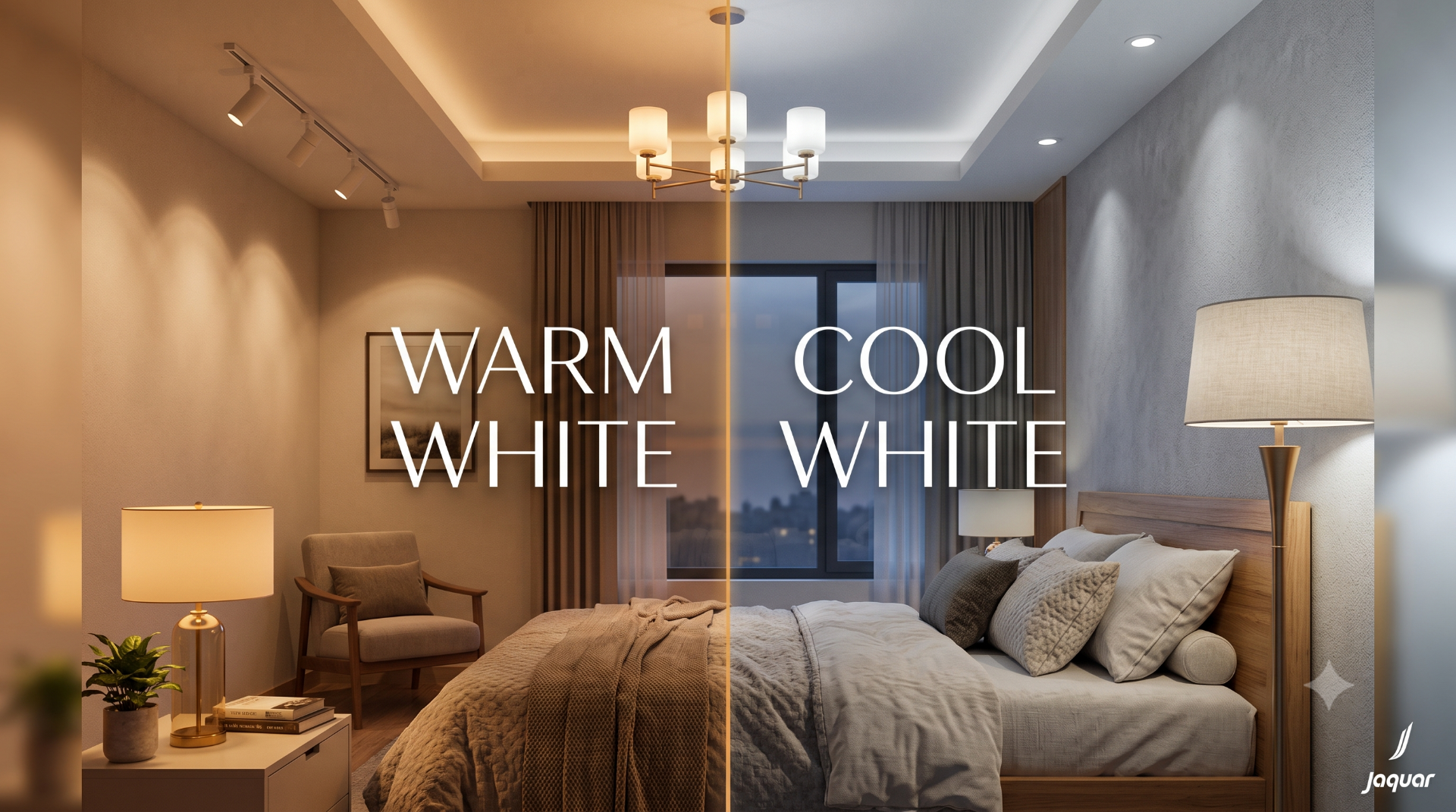
The colour of light can change the way a room feels without changing a single piece of furniture. The same living room, bedroom or dining area can appear warmer and more intimate under one light source and cleaner and more energetic under another.
That difference comes down largely to colour temperature—the characteristic appearance of light measured in Kelvin (K). Warm white tends towards a softer, yellowish appearance, while cool white appears cleaner and more bluish. Neither is universally better. The right choice depends on what the room is used for, the materials and colours within it, the amount of natural daylight and the atmosphere you want to create.
For homes in the UAE, this distinction can be particularly useful. Interiors can receive strong natural daylight during the day and shift to predominantly artificial illumination after sunset. A lighting scheme that works beautifully during daylight hours may feel too stark at night if the colour temperature is not considered carefully.
Understanding warm and cool white lighting therefore goes beyond choosing a bulb or fixture. It is about deciding how a space should look, function and feel throughout the day.
What Does Colour Temperature Mean?
Colour temperature describes the visual warmth or coolness of a light source and is expressed in Kelvin.
The scale can broadly be understood as:
- Warm white: commonly around 2700K–3000K, producing a softer, warmer appearance.
- Neutral white: commonly around 3500K–4000K, offering a more balanced white.
- Cool white: commonly around 5000K–6500K, appearing brighter and more bluish.
These ranges are useful guidelines rather than rigid rules. The exact appearance can vary depending on the fixture, surrounding surfaces and other lighting in the room.
A useful way to think about the difference is not simply "yellow versus white". It is about the atmosphere created by the light and how that atmosphere interacts with the purpose of the room.
Warm White vs Cool White: What Is the Difference?
Warm white generally creates a softer, more relaxed visual environment. It can make timber, warm neutral colours and textured surfaces feel richer and more inviting.
Cool white creates a crisper visual impression. It can make spaces feel more energetic and can be useful where visual clarity and alertness are important.
Neither should be selected in isolation from the room.
A bedroom filled with cool white light may feel overly active in the evening. Conversely, using only warm white in a space where detailed tasks are regularly performed may not provide the visual character some people prefer.
The most effective lighting plans consider the function of each area rather than applying one colour temperature throughout an entire home.
Warm White Lighting: Where Does It Work Best?
Warm white is often associated with comfort and relaxation, making it a natural fit for spaces where people spend time unwinding.
Bedrooms
The bedroom is one of the clearest applications for warmer light.
A warm tone can create a softer atmosphere in the evening and complement upholstered furniture, timber finishes, neutral walls and other residential materials.
It can be especially effective around bedside areas. A wall lamp, pendant or table lamp with a warmer appearance can create a lower, more intimate layer without making the entire room feel brightly illuminated.
Living Rooms
Living rooms often serve several purposes, but relaxation remains an important part of their use.
Warm lighting can complement seating areas and decorative elements while helping the space feel more inviting after sunset.
Rather than using warm light only through a central ceiling fixture, consider combining general indoor lighting with decorative wall lamps, floor lamps or table lamps.
Dining Areas
The dining area can also benefit from warmer illumination because it contributes to a more comfortable social environment.
A pendant or decorative ceiling fixture above the dining table can provide a visual focal point while warmer light complements the table setting and surrounding finishes.
Hospitality-Inspired Home Spaces
If your home includes a reading corner, lounge area or other space designed primarily for relaxation, warmer illumination can help distinguish it from more functional areas.
The key is consistency. If several decorative fixtures are visible from the same space, significant differences in light colour can become distracting.
Cool White Lighting: Where Does It Work Best?
Cooler white light has a cleaner and more energetic appearance, which can be useful in spaces where visual clarity is important.
Work Areas
A home office or study can benefit from a cleaner light appearance, particularly when the space is used for reading, computer work or detailed tasks.
However, brightness and colour temperature are separate considerations. A cool light does not automatically mean that the room should be intensely bright.
Utility-Focused Areas
Areas where practical visibility is the priority can often accommodate cooler lighting more comfortably than relaxation-oriented spaces.
The exact choice should still consider the finishes, natural daylight and the way the area is used.
Dressing Areas
A dressing area can benefit from a cleaner light appearance when the priority is seeing clothing and colours clearly.
This does not necessarily mean the entire bedroom needs cool white illumination. A useful approach can be to keep the main bedroom lighting warmer while giving the dressing area its own functional lighting layer.
What About Neutral White?
Neutral white sits between warm and cool light and can be useful when you want a balanced appearance.
It does not have the distinctly warm character of a 2700K–3000K source or the noticeably cool appearance of higher Kelvin lighting.
For multifunctional areas, this middle ground can be practical.
A home study that also serves as a guest room, for example, may benefit from a more balanced lighting approach. Similarly, corridors and transition spaces can use a neutral appearance when the intention is to connect areas with different lighting schemes.
Warm White vs Cool White for the Living Room
The living room is rarely a single-purpose space, so lighting needs to accommodate different activities.
If the room is primarily used for relaxing, entertaining and watching television, warmer light can work naturally with the furniture and finishes.
If the space also contains a reading area or work zone, consider creating a separate lighting layer rather than changing the entire room to cool white.
A practical arrangement might combine:
- General indoor ceiling lighting
- A decorative pendant or ceiling fixture
- Wall lamps for accent illumination
- A floor lamp near a reading chair
- Table lamps on side furniture
Jaquar's lighting portfolio includes indoor and decorative categories that allow these different layers to be approached as one coordinated lighting scheme.
Warm White vs Cool White for Bedrooms
Bedrooms generally benefit from lighting that supports a slower transition into the evening.
Warm white is often a natural choice for the main bedroom environment because its softer appearance works well with the room's restful purpose.
Bedside lighting deserves particular attention. A wall lamp or table lamp can provide enough illumination for reading without requiring the main ceiling lights to remain on.
For dressing areas within the bedroom, a more neutral or cooler appearance may be considered where clearer visibility is important.
This creates a useful distinction: the bedroom itself can remain visually calm while the dressing zone performs a more functional role.
Warm White vs Cool White for the Kitchen
Kitchens are primarily functional spaces, so clarity becomes more important.
A cleaner light appearance can help with food preparation, organising surfaces and completing detailed tasks.
However, kitchens are also increasingly social spaces. If the kitchen connects directly to a dining or living area, using dramatically different colour temperatures can make the open-plan space feel fragmented.
In such situations, a coordinated lighting plan can use a practical colour temperature for work areas while keeping decorative lighting visually compatible with adjoining rooms.
Warm White vs Cool White for the Dining Area
Dining areas benefit from lighting that makes the room feel comfortable and welcoming.
Warmer light can complement wood, natural textures, neutral finishes and decorative table settings.
A pendant positioned above the dining table can create a concentrated visual zone while the surrounding room remains more subtly illuminated.
Jaquar's decorative lighting portfolio includes pendants and chandeliers that can contribute to this type of focal lighting arrangement.
Warm White vs Cool White for a Home Office
The home office presents a slightly different challenge.
You need sufficient visual clarity for screens, documents and detailed tasks, but the room may also be used for video calls or activities outside working hours.
A balanced lighting scheme can therefore be more useful than choosing the highest possible colour temperature.
Use general lighting to establish a comfortable baseline and add focused illumination where the desk or work surface requires it.
Avoid placing a bright fixture directly behind a monitor or within the camera's field of view, as reflections and visual contrast can become distracting.
How Colour Temperature Affects Interior Colours
Lighting does not exist independently of the room's materials.
Warm light can make warm-toned finishes appear richer and can soften some neutral colours. Cooler light can make whites and cooler surfaces appear crisper.
This matters when selecting lighting for a room with carefully chosen finishes.
For example, if a bedroom contains warm timber and beige upholstery, a very cool light may create a noticeable contrast. Similarly, a space built around crisp white and cooler grey surfaces may respond differently to a strongly warm light.
Always evaluate the light alongside the actual materials rather than relying only on how the fixture appears in a catalogue.
The Importance of Natural Daylight
Natural daylight should be considered before deciding on artificial lighting.
A room with large windows may look significantly cooler or brighter during the day than it does after sunset. Wall colours, curtains, glazing and surrounding buildings can all affect the amount and character of daylight entering the space.
The artificial lighting plan should therefore be considered for both conditions.
Ask:
- What does the room look like during the brightest part of the day?
- Which areas become darker in the evening?
- Does the artificial light complement the existing finishes?
- Does the transition from daylight to artificial light feel comfortable?
These questions often reveal more than simply choosing between two colour temperatures.
Should the Whole Home Use the Same Colour Temperature?
Not necessarily.
Different rooms have different purposes, and applying one colour temperature everywhere can limit how effectively each space functions.
However, rooms that are visually connected should generally have some degree of consistency.
For example, an open-plan living and dining area may benefit from closely related lighting tones, while a bedroom can have a distinctly warmer atmosphere.
The goal is not to make every room identical. It is to create a coherent transition between spaces.
Can Warm and Cool White Be Used in the Same Room?
Yes, but it requires planning.
Different colour temperatures can define separate functional zones. A bedroom might use warmer general lighting while a dressing area uses a more neutral or cooler source for practical visibility.
Similarly, a living room can have warmer decorative lighting while a dedicated reading area uses a different layer.
The key is to avoid mixing temperatures randomly. If two fixtures with visibly different light colours are positioned close together without a clear reason, the result can feel inconsistent.
Choosing Lighting for Large UAE Homes
Larger homes often contain rooms with different functions and generous ceiling heights.
This provides more opportunities to use layered lighting.
A larger living room could combine recessed indoor lighting with decorative wall lamps and a chandelier or pendant. A bedroom could use recessed lighting with bedside wall lamps and a decorative ceiling fixture.
The colour temperature should follow the intended mood of each area rather than the size alone.
Large spaces still benefit from restraint. More fixtures do not necessarily mean better lighting.
Choosing Lighting for Apartments and Compact Spaces
Compact homes need careful lighting because every fixture has a visual impact.
Recessed lighting can preserve a clean ceiling, while wall lamps can provide illumination without occupying furniture surfaces.
Decorative pendants can create a focal point, but their scale should correspond to the room.
In a smaller living room, for example, one carefully selected decorative fixture can contribute more to the interior than several unrelated lights.
How to Choose the Right Colour Temperature
Before selecting a lighting fixture, consider five questions.
1. What is the room used for?
Relaxation-oriented spaces often suit warmer light, while areas requiring sustained visual tasks may benefit from a cleaner appearance.
2. How much natural light enters?
Rooms with strong daylight may need a different artificial lighting approach from rooms that receive limited natural illumination.
3. What are the dominant interior colours?
Consider walls, flooring, furniture and textiles together.
4. Where will the light be viewed from?
A bedside fixture, ceiling fixture and wall lamp are experienced from different angles and distances.
5. Will different fixtures be visible together?
If multiple lights are within the same visual field, their colour appearance should be reasonably coordinated.
Common Mistakes When Choosing Warm or Cool Light
Choosing purely by appearance in a showroom
A fixture can look different in a showroom compared with an actual room because surrounding finishes and daylight affect perception.
Using cool light everywhere
A consistent cool-white scheme can make relaxation-oriented spaces feel more functional than intended.
Using warm light everywhere
Warm light is not automatically suitable for every activity. Spaces requiring detailed visual work may need a different approach.
Mixing colour temperatures without a purpose
Different tones can be useful when they define separate zones. Random mixing can instead make a room feel inconsistent.
Ignoring the fixture design
Colour temperature is only one part of lighting. The fixture's position, distribution, scale and relationship with furniture also matter.
A Practical Room-by-Room Guide
Space | Commonly suitable approach | Why |
Bedroom | Warm white | Creates a softer evening environment |
Living room | Warm to neutral | Balances relaxation and everyday activity |
Dining area | Warm white | Supports a comfortable social atmosphere |
Study/home office | Neutral to cool | Supports visual clarity |
Dressing area | Neutral to cool | Helps with practical visibility |
Kitchen | Neutral to cool | Useful for detailed tasks |
Reading corner | Warm to neutral | Provides focused but comfortable illumination |
Hallway | Neutral to warm | Creates a smoother transition between rooms |
These are starting points rather than fixed rules. The right choice still depends on the room's finishes, daylight, fixture type and personal preference.
How Jaquar Lighting Fits Into a Colour-Temperature Plan
Choosing colour temperature becomes easier when the lighting plan is considered as a complete system rather than fixture by fixture.
Jaquar's lighting portfolio spans indoor and decorative solutions, including recessed and other indoor lighting, ceiling and hanging fixtures, as well as decorative chandeliers, pendants, floor lamps, table lamps and wall lamps.
This allows different lighting layers to be considered together: general illumination for the room, focused sources for functional areas and decorative fixtures for visual character.
The objective is not to fill a home with more lights. It is to choose the right combination for the way each space is actually used.
Frequently Asked Questions
1. Is warm white or cool white better for a home?
Neither is universally better. Warm white is commonly suited to relaxation-oriented areas, while cooler light can be useful where visual clarity and focused activity are priorities. The room's purpose, finishes and daylight should guide the choice.
2. Is warm white better for bedrooms?
Warm white is often well suited to bedrooms because its softer appearance complements a restful environment, particularly in the evening. Bedside wall lamps, table lamps or pendants can reinforce this effect.
3. Is cool white suitable for a living room?
It can be, particularly where the living room is also used for work or detailed activities. However, warmer or more neutral lighting is often considered when relaxation and social use are the primary functions.
4. Can warm and cool white lights be used together?
Yes. They can be used to distinguish different functional zones, but the combination should have a clear purpose. Using noticeably different colour temperatures randomly within the same visual area can look inconsistent.
5. What colour temperature should I choose for an open-plan home?
Consider the functions of each zone while maintaining reasonable visual consistency between connected areas. Living and dining spaces may use related warmer tones, while a dedicated work or dressing zone can use a more functional lighting approach.
Conclusion
Warm white and cool white are not competing answers to the same question. They serve different visual and functional purposes.
The better approach is to consider each room as a combination of activity, atmosphere, architecture and material. Warm white can create a softer environment for bedrooms, living rooms and dining spaces, while neutral or cooler lighting can support areas where clarity and concentration matter more.
The strongest lighting schemes also recognise that colour temperature is only one part of the decision. Fixture placement, natural daylight, light distribution, room proportions and the relationship between different lighting layers all influence the final result.
Jaquar's range of indoor and decorative lighting provides different fixture formats that can be incorporated into these layered approaches, from recessed and ceiling lighting to pendants, chandeliers, wall lamps, floor lamps and table lamps.
A coordinated lighting portfolio makes it easier to maintain consistency while using different fixtures for different purposes. The result is lighting that supports the way your home is actually lived in—functional when it needs to be, and comfortable when the day winds down.