

Buying a new light bulb should be straightforward, yet the information on the packaging often raises more questions than answers. Many people are familiar with watts because they were used for decades to judge how bright a bulb would be. Today, however, LED technology has changed the way we choose lighting.
If you are comparing bulbs, understanding a lumens to watts conversion chart can make the process much easier. It helps you choose the correct brightness for your space, avoid buying bulbs that are too bright or too dim and make smart choices without consuming more energy.
Why Lumens Matter More Than Watts?
One of the biggest misconceptions about lighting is that the higher the wattage, the brighter the light bulb. This was generally true for traditional incandescent lamps because they were less efficient at producing light.
Modern lighting is different. LEDs produce much more light, using a lot less electricity. This means that two bulbs with very different wattages can produce the same amount of light.
In simple terms:
- Lumens are a measure of the amount of light a bulb produces.
- Watts measure how much electrical power the bulb consumes.
When choosing a new bulb, it is the lumen rating that tells you how bright the light will be.
Lumens to Watts Conversion Chart
The table below provides a simple guide for replacing traditional incandescent bulbs with LED and CFL alternatives.
Brightness (Lumens) | LED | CFL | Incandescent |
250–300 lm | 3–4 W | 5–7 W | 25 W |
450 lm | 5–6 W | 8–10 W | 40 W |
800 lm | 8–10 W | 13–15 W | 60 W |
1,100 lm | 10–13 W | 18–20 W | 75 W |
1,600 lm | 15–18 W | 23–30 W | 100 W |
This lumens to watts conversion chart provides approximate equivalents. Actual performance may vary slightly depending on the manufacturer and bulb design.
Understanding Incandescent Bulbs vs LED Bulbs
The discussion regarding the Incandescent Bulbs vs. LED Bulbs often revolves around the use of electricity but there are a number of significant differences.
Incandescent bulbs waste much of their electricity as heat instead of light. LEDs, however, are designed to produce more light while using significantly less power. This makes them a practical choice for home, office and commercial use.
LED lighting has a longer working life, lower maintenance requirements and a wide range of colour temperatures and beam angles to suit different applications.
Choosing the Right Brightness for Every Room
Different rooms require different levels of illumination depending on how the space is used.
1. Living Room
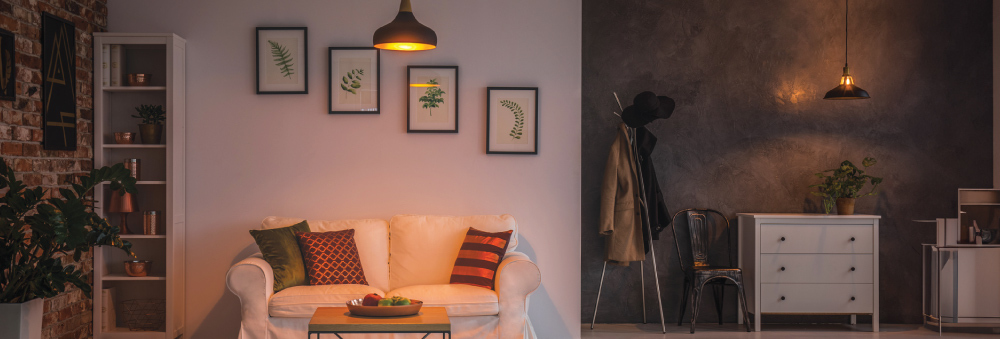
A comfortable living room usually benefits from bulbs between 800 and 1,600 lumens, depending on the room size and the number of light fittings.
2. Bedroom
Bedrooms generally work well with softer lighting. Bulbs around 400 to 800 lumens help create a calm and relaxing environment.
3. Kitchen
Food preparation areas require brighter lighting. Bulbs between 800 and 1,600 lumens are commonly suitable for general kitchen lighting.
4. Bathroom
Bathrooms often need clear, even illumination, particularly around mirrors. Bulbs delivering 800 lumens or more are typically preferred.
5. Home Office
For reading, writing and computer work, brighter lighting can improve visibility. A range of 800 to 1,600 lumens is often appropriate depending on the workspace.
Understanding Warm White vs Cool White Lighting
Brightness is only one part of selecting the right bulb. Colour temperature also plays an important role.
When comparing warm white vs cool white lighting, you are choosing the appearance of the light rather than its brightness.
- Warm White (around 2700K to 3000K): Creates a soft and welcoming atmosphere that suits bedrooms, living rooms and lounges.
- Neutral White (around 3500K to 4000K): Provides balanced illumination suitable for many everyday spaces.
- Cool White (around 5000K and above): Produces a brighter, crisper appearance that is often selected for kitchens, bathrooms and workspaces.
Selecting the appropriate colour temperature helps ensure the lighting complements the purpose of the room.
Why Beam Angle Matters?
Beam angle is how widely light is scattered.
A narrow beam angle focuses the light into a small area, which makes it good for highlighting artwork or architectural details. A wider beam spreads light more evenly around the room and is useful for general lighting.
Along with brightness, the beam angle should be taken into account to create a comfortable and well-balanced lighting scheme.
Practical Tips Before Buying
Before purchasing a bulb, keep a few simple points in mind.
- Check the lumen value rather than relying only on wattage.
- Select a colour temperature that suits the function of the room.
- Consider the beam angle for the intended application.
- Ensure the bulb is compatible with your existing light fitting.
- Compare brightness instead of simply trying to convert lumens to watts.
Some people also search for a watts to lumens calculator, convert watts to lumens calculator, lumen watt conversion or watts to lumens conversion tool. While these can offer a useful estimate, referring to the bulb packaging and a reliable conversion chart is often the simplest way to choose the correct replacement.
Common Mistakes to Avoid
Choosing lighting becomes much easier when a few common mistakes are avoided.
Do not assume that a higher wattage always produces more light. Don’t choose bulbs based on watt figure alone; you could end up with lighting that’s too dim or brighter than you need. Also worth checking is the colour temperature, especially if you are replacing bulbs in an existing room so the overall look is consistent.
Knowing the basics can make it easier to choose energy efficient lighting solutions that give the right amount of brightness while helping to cut down on electricity use.
FAQs:
Q. What is the difference between lumens and watts?
A. Lumens measure the amount of light produced, while watts measure the amount of electricity a bulb consumes.
Q. How many watts is an 800-lumen LED bulb?
A. An LED bulb producing around 800 lumens typically uses approximately 8 to 10 watts, depending on the manufacturer.
Q. How many lumens do I need for a living room?
A. Most living rooms benefit from lighting between 800 and 1,600 lumens, depending on the room size and layout.
Q. Why are lumens more important than watts?
A. Lumens indicate brightness directly, making it easier to compare modern lighting technologies that use different amounts of power.
Q. Which LED bulb replaces a 100W incandescent bulb?
A. A bulb producing approximately 1,600 lumens, usually around 15 to 18 watts, is commonly used as an equivalent replacement.
Q. Does higher wattage always mean brighter light?
A. No. With modern LED technology, bulbs can deliver high brightness while using much lower wattage than traditional incandescent lamps. This is why checking the lumen value is the best way to compare brightness.
#Tags:
800 lumens to watts, 300 lumens to watts, 100 lumens to watts, 1 lumens to watts, 400 lumens to watts, lumens to watts calculator, lumens to watts converter